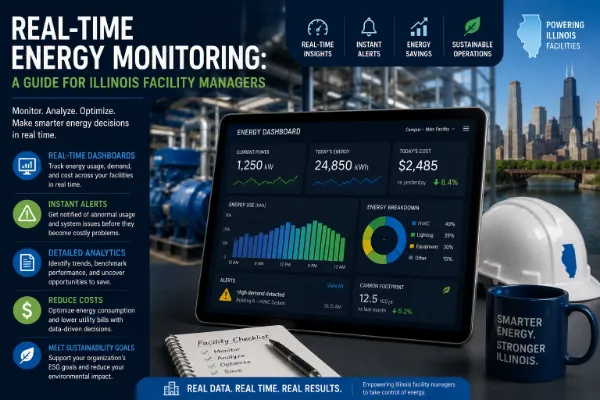
A commercial property owner usually sees electricity as a monthly bill, one number on one invoice. That number hides a lot: tenants who use far more than others, equipment that runs all night, a demand spike that sets the charge for the whole month. Energy monitoring breaks the bill into pieces so that owners can see where money goes and fix what can be fixed. This guide is for owners and managers of offices, retail centers, multifamily buildings and mixed-use properties in Energy & Sustainability. Our earlier piece on real-time energy monitoring for facility managers covers the basics. This one is about the business case and how to set up a program across a property portfolio.
| Goal | What Monitoring Provides |
|---|
| Cut cost | Finds waste, shows demand peaks, verifies savings from projects |
| Bill tenants fairly | Submeter data to allocate costs by actual use |
| Meet reporting needs | Data for benchmarking, sustainability reports and lender or investor requests |
| Protect equipment and uptime | Alerts for abnormal loads and failing equipment |
Before buying hardware, read the bills. Commercial customers in Illinois typically pay for energy used, plus demand charges based on the highest short-interval draw each month, plus delivery and other charges. Rate class matters. Ask your utility for interval data, which is often available online, and look at load shapes. A flat nighttime load suggests equipment left on. A sharp afternoon spike suggests cooling or start-up loads that could be staggered. Many owners find savings from rate selection and scheduling before installing anything.
- Whole-building meters: Utility interval data or a revenue-grade meter at the main service.
- Major systems: Chillers, boilers, air handlers, rooftop units, elevators and lighting panels.
- Tenant spaces: Submeters at each tenant or floor for billing and benchmarking.
- Special loads: EV chargers, data rooms, kitchens, refrigeration and parking garages.
- Generation and storage: Solar and battery output, covered in solar and battery optimization.
- Context: Outdoor temperature, occupancy and schedules, so you can explain changes.
Clamp-on current sensors install without shutting down panels and suit retrofits. Revenue-grade submeters are needed for tenant billing. Wireless meters reduce cabling cost, though they need good signal in electrical rooms. Utility-provided interval data is a low-cost start. Whatever you pick, check accuracy class, data resolution and how data reaches your platform. Building automation systems may already record much of what you need, a point developed in IoT HVAC monitoring in large buildings.
- Normalize. Compare energy by square foot, weather and occupancy so buildings can be compared fairly.
- Set baselines. Record a year of normal use before projects so you can prove savings.
- Alert on exceptions. Examples include a sudden after-hours load, a demand spike or a meter that stops reporting.
- Assign owners. Each finding needs someone to act and a date to review.
- Report regularly. Share summaries with executives, tenants and lenders.
Submetering can make billing fairer, but it must be implemented carefully. Check lease terms, local rules and metering accuracy requirements. Explain methods to tenants, give them access to their own data and handle disputes quickly. Tenants who see their data often reduce usage. In multifamily buildings, similar ideas apply, see smart property management for multifamily.
Chicago requires annual energy reporting for large buildings, and public ratings can influence leasing and sale discussions. Good submeter data simplifies reporting and shows improvement. See smart buildings in Chicago for rules and context, and confirm current requirements with the City.
Electric vehicle chargers, electrified heating and data-heavy tenants raise demand and change load shapes. Monitoring helps owners plan service capacity and avoid costly surprises. EV-specific issues are covered in managing EV charging load with IoT, and large power users in data center growth and connected energy monitoring.
Typical benefits include lower energy and demand charges, fewer equipment failures, reduced staff time spent on manual readings, recovered tenant costs and lower risk of billing disputes. Costs include sensors, installation, software subscriptions and staff time to act on findings. Avoid promising a standard percentage of savings, since results depend on the building's starting condition and whether findings are acted on. Funding or incentive programs may reduce cost, see Illinois IoT funding and grants, and check utility efficiency programs for rebates.
Consider a 250,000 square foot retail center in the Naperville area with twenty tenants and a landlord-owned common area. The owner's bills have risen, and tenants dispute common area charges. The owner installs submeters at tenant panels and on rooftop units, parking lot lighting and the central cooling plant. Data shows lights running well beyond schedule and two rooftop units cycling heavily. The owner fixes schedules and repairs the units, and offers tenants monthly usage summaries. Common area costs fall, disputes decline and the owner uses the data to negotiate a better rate structure. See local providers on the Naperville Energy & Sustainability page.
Dozens of meters create dashboards nobody reads. Start with the top loads and a few alerts.
Missing readings and wrong multipliers mislead. Validate data against utility bills.
Owners invest, tenants benefit. Align through lease terms and cost recovery.
Meters and gateways are networked devices. Segment them and manage access, as in industrial IoT cybersecurity.
Expect more building meters with built-in analytics, more utility programs that pay for flexibility and more demand from lenders and tenants for reported energy data. See smart grid IoT in Illinois for the utility side.
Browse more Energy & Sustainability articles and the Chicago Energy & Sustainability directory.
It is the collection and analysis of electricity, gas and water use at the building, system and tenant level, so owners can find waste, bill fairly and report results.
The utility meters the whole building. Submeters measure parts of it, such as tenant spaces or major equipment, so costs and waste can be traced to their sources.
Often yes, but you should confirm lease terms, local rules and meter accuracy requirements, and be transparent with tenants about methods.
It is a utility charge based on the highest short-interval power draw in a billing period. Monitoring shows what causes peaks so you can reduce or stagger loads.
Some savings, such as fixing schedules, appear within weeks. Others, such as equipment tuning or rate changes, take a few months. Record a baseline so you can measure results.
Utility interval data is a good starting point. Add submeters where you need tenant billing, system-level detail or equipment alerts that utility data cannot provide.
Frequently asked questions
It is the collection and analysis of electricity, gas and water use at the building, system and tenant level, so owners can find waste, bill fairly and report results.
The utility meters the whole building. Submeters measure parts of it, such as tenant spaces or major equipment, so costs and waste can be traced to their sources.
Often yes, but you should confirm lease terms, local rules and meter accuracy requirements, and be transparent with tenants about methods.
It is a utility charge based on the highest short-interval power draw in a billing period. Monitoring shows what causes peaks so you can reduce or stagger loads.
Some savings, such as fixing schedules, appear within weeks. Others, such as equipment tuning or rate changes, take a few months. Record a baseline so you can measure results.
Utility interval data is a good starting point. Add submeters where you need tenant billing, system-level detail or equipment alerts that utility data cannot provide.
Related articles

 Energy & Sustainability