An Extreme Cold Warning covering all of northern Illinois in early 2026 brought wind chills as low as 30 degrees below zero to the Rockford area alone. "This is going to be a dangerous cold event that will spread across our entire system," ComEd's David Perez, the utility's executive vice president and chief operating officer, said as crews prepared for widespread outage response. Illinois has faced repeated polar vortex-driven Arctic air surges through 2026, part of a broader pattern meteorologists describe as a wavier jet stream combined with periodic stratospheric disruption pushing dangerous cold south into the state more often than in a typical winter. For Illinois building owners, this recurring extreme cold pattern makes IoT-based freeze monitoring less an optional upgrade and more a genuine survival tool.
Chicago's bungalow belt the dense ring of 1920s and 1940s-era single-family and two-flat housing stock spanning neighborhoods like Cicero and Berwyn carries a genuinely distinctive vulnerability to extreme cold that newer construction doesn't share. These buildings typically run half-inch copper or galvanized steel water supply lines through attic spaces, visible against the attic floor framing, with insulation levels that frequently still reflect the original 1920s or 1940s-era construction standard rather than Illinois's current energy code minimum. Bringing bungalow-belt attic floor insulation up from the original R-11 level to Illinois's current R-38 code minimum doesn't just reduce freeze risk directly it typically pays back in energy savings within just two to four heating seasons, making this specific upgrade one of the more financially compelling freeze-prevention investments available to owners of this particular building type.
Compounding the insulation gap, much of Chicago's older residential plumbing stock, including lead piping that remained standard through the 1930s and stayed in service in many buildings well beyond that, creates additional complexity for any freeze-prevention retrofit modernizing supply lines in these buildings often intersects directly with lead service line replacement work already underway across Chicago for water quality reasons entirely separate from freeze protection. Owners of bungalow-belt properties undertaking any plumbing-related freeze prevention project should factor in whether the same work creates a natural opportunity to address legacy lead piping simultaneously, since separating these two renovation needs into distinct future projects generally costs more in aggregate than addressing them together during a single plumbing-focused renovation.
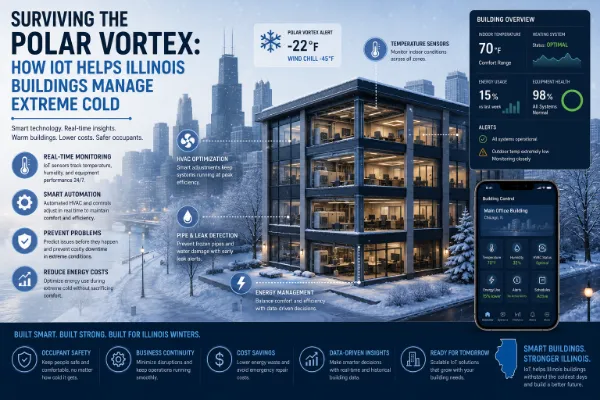
Continuous temperature sensors placed specifically in a building's genuinely vulnerable zones unheated attic spaces where supply lines run, crawl spaces beneath ground-level additions common in converted bungalow-belt two-flats, and mechanical rooms housing fresh air dampers, covered in more detail in this site's broader coverage of Illinois commercial building heating challenges can detect a developing freeze risk hours before a pipe actually bursts. This matters enormously given how these failures typically play out in practice: a frozen pipe bursting while residents are away at work or on travel can run for hours or days undetected, and by the time anyone discovers the resulting flood, damage has often already spread across multiple rooms or floors below the original failure point. An alert firing when a monitored zone's temperature drops toward the freeze threshold gives an owner or property manager a genuine window to intervene running a space heater, opening cabinet doors to allow warmer air circulation, or dispatching a plumber preemptively before a pipe actually fails, rather than only learning about the problem after the damage is already done.
The stratospheric disruption pattern driving Illinois's repeated 2026 cold surges reflects something genuinely worth understanding for building owners planning freeze prevention investment: rather than a single, well-forecast cold snap that a building can prepare for once and move past, this pattern produces cold intrusions that pulse through in waves over multiple weeks, meaning a building's freeze protection needs to hold up across repeated extreme cold events within a single winter, not just survive one isolated storm. Continuous, always-on monitoring is considerably better suited to this kind of recurring, multi-wave cold pattern than a one-time seasonal preparation checklist completed each November and not revisited until the following year a building genuinely needs freeze monitoring active and responsive throughout the entire winter season given how unpredictably these cold waves have continued arriving through 2026.
Extreme cold events create a genuine secondary risk beyond direct freeze damage: widespread power outages during exactly the conditions when heating systems matter most. ComEd's own public messaging during the early 2026 extreme cold warning specifically emphasized crew readiness for rapid outage restoration across the utility's entire system a recognition that a power outage during subzero wind chill conditions compounds freeze risk directly, since a building's heating system, however well-maintained, can't function without electricity. For a building with battery backup or generator capacity, covered in more detail in this site's broader coverage of Illinois solar and battery optimization, IoT monitoring that tracks both freeze conditions and power availability simultaneously provides a more complete picture of actual building risk during an extreme cold event than temperature monitoring alone.
Given how directly frozen pipe damage translates into costly water damage claims, Illinois property owners investing in IoT freeze monitoring should specifically ask their insurance carrier whether documented, continuous monitoring affects premium calculations or claims processing. Some carriers offer meaningful credits for verified freeze prevention systems, and given how well-documented Illinois's repeated 2026 cold events have become in local and national coverage, insurers may increasingly expect to see proactive freeze monitoring as a baseline underwriting expectation for older, higher-risk building stock like Chicago's bungalow belt, rather than treating it as an optional enhancement.
For an Illinois building owner evaluating freeze prevention investment, the practical priority sequence should start with the specific building type's known vulnerability bungalow-belt attic supply lines and crawl space additions for the 1920s-1940s housing stock covered throughout this article, mechanical room fresh air dampers for commercial buildings covered in more detail elsewhere on this site before expanding to broader whole-building monitoring. Given how directly Illinois's 2026 winter pattern has demonstrated genuinely repeated, multi-wave extreme cold events rather than isolated storms, that monitoring investment should be treated as a full-season commitment, not a one-time seasonal check completed before the first hard freeze and then set aside.
Having a monitoring system in place only delivers value if a building has a clear, pre-established response plan for when it actually fires an alert plumbing guidance for a suspected frozen pipe consistently emphasizes leaving faucets running slightly to relieve pressure, opening cabinet doors to let warmer room air reach exposed plumbing, and using only gentle, indirect heat sources like hair dryers or heating pads rather than open flames or fuel-burning portable heaters, which introduce genuine fire and carbon monoxide risk precisely when a building's ventilation may already be compromised by extreme cold. Building owners setting up IoT freeze monitoring should pair the technology with a written, distributed response protocol covering exactly these steps, rather than assuming staff or residents will know the correct response in the moment an alert actually arrives.
Frequently asked questions
An Extreme Cold Warning covering northern Illinois brought wind chills as low as 30 degrees below zero to the Rockford area, part of a broader pattern of repeated Arctic air surges affecting the state through 2026.
These 1920s and 1940s-era buildings typically run water supply lines through unheated attic spaces with insulation still reflecting original construction standards, well below Illinois's current R-38 code minimum, unlike newer construction.
Raising attic floor insulation from the original R-11 level to the current R-38 code minimum directly reduces freeze risk while typically paying back in energy savings within two to four heating seasons.
Much of Chicago's older plumbing includes lead piping that remained standard through the 1930s, meaning freeze-prevention plumbing work often intersects with separate, ongoing lead service line replacement efforts already underway citywide.
Illinois's 2026 cold pattern reflects stratospheric disruption producing repeated Arctic air surges over multiple weeks rather than a single forecastable storm, meaning freeze protection needs to hold up across repeated cold waves throughout the winter.
A power outage during subzero conditions compounds freeze risk directly, since heating systems can't function without electricity, making combined freeze-and-power monitoring more complete than temperature tracking alone.
Related articles

 Energy & Sustainability