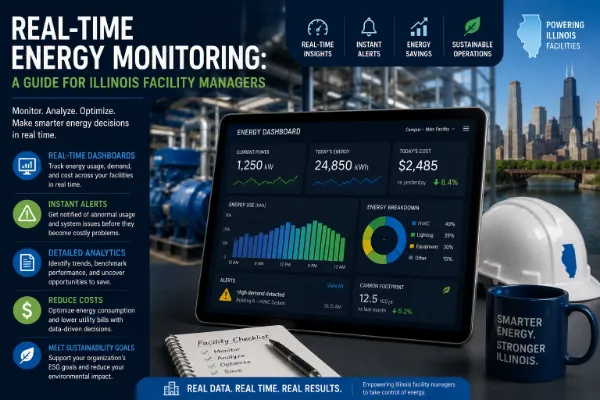
Illinois facility managers are navigating a genuinely more complex utility rate environment than they were just a few years ago. The Climate and Equitable Jobs Act replaced the old formula rate-making system that governed ComEd and Ameren delivery rates with Performance-Based Rate-Making, meaning delivery rates now shift with each utility's periodic capital investment cases rather than following a more predictable, longer-established formula. This guide walks through how to set up energy monitoring that keeps pace with that shift, rather than one built around assumptions from Illinois's older, more static rate environment.
Before evaluating monitoring hardware, confirm whether a facility sits in ComEd's northern Illinois PJM-connected territory or Ameren's central and southern Illinois MISO-connected territory, covered in more detail in this site's coverage of Illinois solar and battery optimization these represent genuinely separate grid systems with different capacity auction dynamics, different underlying cost pressures, and increasingly different rate trajectories. A monitoring and demand management strategy built around ComEd's specific rate structure won't necessarily translate cleanly to an Ameren facility, and vice versa, making this the essential first step before any technical monitoring deployment decision.
Given how directly Performance-Based Rate-Making now ties delivery charges to each utility's ongoing capital investment cases, Illinois facility energy monitoring needs to track the delivery and supply components of a bill separately, rather than monitoring only total kWh consumption. A facility that reduces overall energy use but doesn't understand how the delivery charge portion of its bill is trending independently risks missing a meaningful cost driver that has genuinely little to do with the facility's own consumption behavior delivery rate increases tied to grid hardening and infrastructure investment apply regardless of how efficiently a specific facility operates, making this a cost category worth tracking on its own rather than assuming it moves in lockstep with total usage.
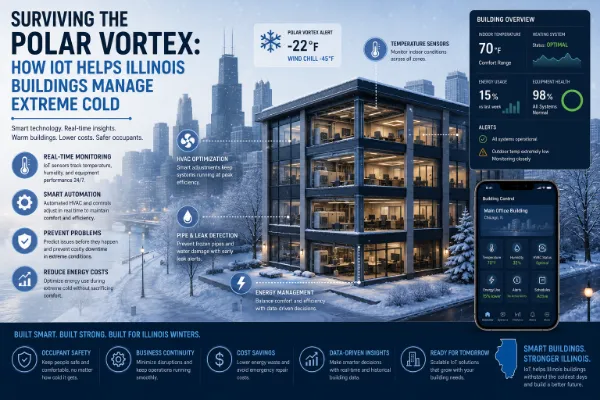
As covered in more depth in this site's broader coverage of Illinois's demanding winter and summer climate swings, HVAC remains the largest controllable energy expense for the overwhelming majority of Illinois commercial buildings, and the state's genuine dual-season extremes subzero winters and humid summers make continuous, year-round monitoring considerably more valuable here than in a milder climate. Circuit-level HVAC monitoring should be configured to flag both winter freeze-risk conditions, like a failing fresh air damper allowing subzero air into a mechanical room, and summer dehumidification failures, rather than a monitoring approach calibrated around only one seasonal extreme.
Given how directly Illinois delivery rates now shift with each utility's periodic Performance-Based Rate-Making case, facility managers should build a monitoring and budgeting calendar that explicitly tracks known or anticipated rate case timelines alongside standard consumption alerts. A facility that only monitors for unusual consumption spikes, without also tracking when a utility's next rate case is likely to affect delivery charges, risks being caught off guard by a delivery rate increase that has nothing to do with the facility's own energy behavior exactly the kind of cost driver that's become considerably more consequential under Illinois's post-CEJA rate-making structure than it was under the older formula rate system.
| Building Scenario | Typical Investment | What's Included |
|---|
| No existing BMS, wireless overlay | $0.50–$1.50 per sq ft | Circuit submetering, zone sensors, cloud dashboard |
| Existing BMS, integration and gap-filling | $0.25–$0.75 per sq ft | Bridging existing controls to a modern analytics platform |
| Delivery-versus-supply cost tracking and rate case alerting | Varies by platform | Separate billing-component monitoring, rate case calendar integration |
These base hardware costs track closely with national averages, but the practical business case in Illinois increasingly needs to explicitly separate delivery cost risk from supply cost risk as a distinct line item, given how independently these two cost categories can now move under the state's post-CEJA rate structure.
For Illinois facilities with existing or planned solar and battery installations, energy monitoring can't be treated as a separate system from battery dispatch optimization, covered in more depth elsewhere on this site the same granular consumption and cost-component data needed to track delivery charge volatility is also exactly what a battery dispatch system needs to correctly prioritize self-consumption under Illinois's post-2025 supply-only net metering rules. Facility managers evaluating monitoring platforms should specifically confirm integration capability with any existing or planned battery management system, since running these as two disconnected platforms means neither system has full visibility into the actual optimization problem the building faces under Illinois's current rate structure.
For an Illinois facility manager evaluating this investment for the first time, a reasonable starting point is pulling twelve months of actual utility bills and separating them explicitly into supply, delivery, and any applicable credit line items a step that costs nothing and often reveals which cost category is actually driving a facility's rising energy expense before any new hardware gets installed at all. In many cases, this review reveals that delivery charges, not supply or consumption, account for a disproportionate and growing share of total cost under Illinois's current Performance-Based Rate-Making structure, a finding that should directly inform which monitoring capability a facility prioritizes first.
- Monitoring built for the old formula rate system. A platform configured around assumptions of stable, predictable delivery rates will misrepresent actual cost trends under the newer Performance-Based Rate-Making structure.
- Treating ComEd and Ameren rate dynamics as interchangeable. A facility with locations in both territories needs genuinely separate monitoring and budgeting assumptions for each, given their different grid systems and cost pressures.
- Underestimating winter freeze risk in monitoring thresholds. Given the genuinely demanding cold covered in more detail elsewhere on this site, monitoring calibrated primarily around summer cooling load may significantly underestimate winter equipment failure risk.
- Ignoring the nuclear bill credit mechanism. ComEd customers received significant bill credits in 2026 under CEJA's nuclear plant price-sharing framework, and facility managers should confirm their monitoring and budgeting properly accounts for these credits rather than treating monthly bill totals as a pure reflection of consumption and rate trends alone.
Illinois facility managers face the same basic choice common across markets standalone submetering hardware with a basic dashboard, versus a fuller platform bundling monitoring, rate-case-aware alerting, and battery integration together but with an Illinois-specific consideration worth weighing directly: a standalone point solution puts the burden of correctly tracking each utility's Performance-Based Rate-Making case timeline entirely on the facility team, a genuinely nontrivial task given how recently this rate-making structure took effect and how limited the pool of vendors with documented Illinois-specific implementation experience remains. A bundled platform with rate-case tracking built in generally costs more upfront but removes a meaningful source of missed-cost-driver risk, which for most facility teams without dedicated energy analytics staff tends to be the more reliable choice.
Frequently asked questions
Performance-Based Rate-Making ties delivery charges to each utility's ongoing capital investment cases, meaning delivery costs can rise independently of a facility's actual consumption behavior, making separate tracking necessary to understand true cost drivers.
Yes. The two utilities operate on separate grids with different capacity dynamics and rate pressures, meaning a monitoring and demand strategy calibrated for one doesn't necessarily apply to the other.
HVAC monitoring remains the single largest controllable expense for most facilities, and Illinois's genuine dual-season climate extremes make year-round, not just seasonal, monitoring particularly valuable.
Base hardware costs track national averages, roughly $0.50 to $1.50 per square foot for a wireless overlay system, though the business case increasingly needs to separate delivery cost risk from supply cost risk given Illinois's current rate structure.
Under CEJA's framework requiring nuclear plants to share revenue with customers when prices are high, ComEd distributed significant bill credits in 2026, and facility managers should ensure their monitoring accounts for these credits separately from underlying consumption trends.
Yes, wherever both exist. The same granular cost-component data needed for delivery charge tracking is also what a battery dispatch system needs to correctly prioritize self-consumption under Illinois's current net metering rules.
Related articles

 Energy & Sustainability