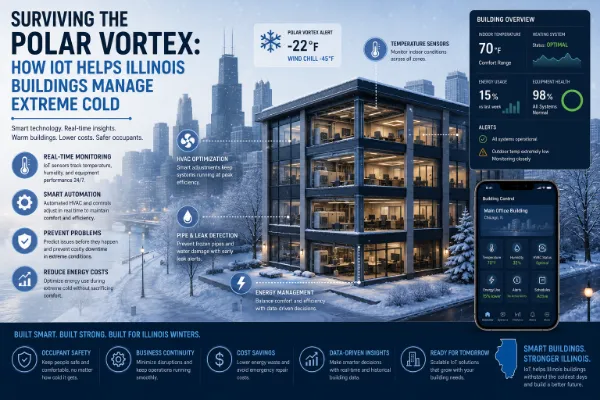
Illinois solar economics genuinely bifurcated on January 1, 2025. Under the state's Climate and Equitable Jobs Act, new solar customers interconnecting with ComEd, Ameren Illinois, or MidAmerican Energy moved to supply-only net metering credits now apply only to the supply portion of a customer's bill, not delivery charges or fixed fees, while customers who had systems installed and fully documented before that deadline retain full retail-rate netting for the entire 30-year life of their generator. That split matters directly for how IoT-driven battery optimization should actually work in Illinois today, since a system installed in 2024 and a system installed in 2026 are now operating under genuinely different economic rules, even sitting on neighboring rooftops.
Under the prior full retail-rate structure, a solar system exporting excess generation to the grid received credit against both the supply and delivery portions of a customer's bill meaning the value of exported power roughly matched the value of power the system offset through self-consumption. Under the new supply-only structure, that symmetry breaks: a system exporting 200 kWh in a month might receive a credit of only around $13.60 at ComEd's roughly 6.8-cent supply rate, while delivery charges and fixed fees continue accruing regardless of how much a customer's system exports. This changes the underlying optimization math directly under the new rules, self-consumption of solar generation is worth meaningfully more than export credit, since self-consumed power avoids both the supply and delivery cost a customer would otherwise pay, while exported power only earns credit against the smaller supply-only portion.
This dynamic pushes Illinois solar economics in the same direction covered in this site's broader coverage of net metering shifts in other states toward battery storage and active self-consumption management becoming the primary lever for capturing value from a solar investment, rather than exporting freely and relying on generous net metering credit to handle the rest. A battery dispatch system optimized for Illinois's post-2025 rate structure needs to prioritize storing midday solar production specifically to offset a household or business's own evening consumption, rather than defaulting to grid export, since self-consumed stored energy is now worth considerably more than the supply-only export credit a customer would otherwise receive for that same unit of power.
Illinois's Distributed Generation Rebate program, maintained and expanded under CEJA, offers a direct utility cash payment of $250 per kilowatt of solar capacity and $300 per kilowatt-hour of battery storage capacity installed a genuinely substantial incentive, since a 7-kilowatt solar system paired with a 10-kilowatt-hour battery can earn $5,100 in combined rebates on top of separate Illinois Shines SREC payments. Qualifying for this rebate requires installing a smart inverter capable of communicating directly with the utility, allowing ComEd or Ameren to fine-tune the power flowing from a customer's system to help stabilize the local grid a genuinely direct IoT integration point between a customer's own solar and battery system and the utility's broader grid management infrastructure. It's worth understanding the real tradeoff embedded in this rebate, though: accepting it locks a customer into supply-only net metering permanently, meaning the small number of homeowners still grandfathered into full retail net metering from before January 2025 should think carefully before accepting the rebate, since that decision isn't reversible and the long-term value of retained full retail metering may exceed the rebate's immediate cash value depending on a household's specific consumption pattern.
Illinois's two major investor-owned utilities operate on entirely separate regional grids with different underlying cost pressures, a distinction that matters directly for battery optimization strategy depending on which territory a property sits in. ComEd, serving northern Illinois and Chicagoland, operates on the PJM Interconnection grid, while Ameren Illinois, serving central and southern Illinois, operates on the MISO grid different capacity auction dynamics driving different rate pressures in each territory. Ameren's delivery rate has climbed roughly 94% since 2021, reaching approximately 15.5 cents per kilowatt-hour by 2026, driven partly by CEJA's mandated coal plant closures outpacing new replacement generation capacity coming online in the MISO region specifically a dynamic that doesn't apply identically to ComEd's PJM-connected territory. A battery optimization strategy calibrated purely around ComEd's rate structure and grid conditions won't translate directly to an Ameren territory deployment, and vice versa, making utility-specific rate and grid condition awareness a genuine prerequisite for effective IoT-driven dispatch planning anywhere in Illinois.
CEJA also ended the controversial "formula rate-making" system that previously governed how ComEd and Ameren set delivery rates, replacing it with a Performance-Based Rate-Making model requiring utilities to demonstrate that capital investments grid hardening, smart meter deployment, EV charging infrastructure actually deliver measurable customer value before those costs get passed through in delivery rates. By 2026, the first wave of these performance-based rate cases has begun showing up directly in the delivery portion of customer bills, adding a genuinely new layer of rate volatility that IoT-based energy monitoring, covered in more detail in this site's broader guide for Illinois facility managers, needs to track continuously rather than assuming delivery rates will remain stable between traditional periodic rate cases the way the old formula rate system provided.
Given how recently Illinois's net metering structure shifted, property owners evaluating battery dispatch vendors should push past generic marketing claims and ask pointed questions specific to this state's actual rules: does the platform's dispatch algorithm explicitly distinguish between supply-only and full retail net metering customers, or does it apply a single, generic optimization logic regardless of which structure a specific installation falls under? Can the vendor demonstrate, with actual Illinois installation data, how their system handles the ComEd-versus-Ameren grid distinction covered above? And does the vendor have documented familiarity with Illinois's Performance-Based Rate-Making structure specifically, given how directly that affects the delivery-charge side of the optimization problem a battery system installed here actually needs to solve?
For anyone in Illinois evaluating a new solar and battery investment in 2026, the practical planning sequence needs to start with confirming which specific net metering structure applies supply-only for any new interconnection, full retail only for systems documented before the January 2025 deadline before modeling expected returns, since these two structures produce genuinely different payback timelines for otherwise identical hardware. From there, IoT-driven dispatch software needs to be explicitly configured around self-consumption maximization rather than export optimization for any post-2025 system, and utility territory ComEd's PJM-connected northern Illinois grid versus Ameren's MISO-connected central and southern Illinois grid should inform both rate assumptions and awareness of broader regional capacity pressure that could affect future rate trajectories.
Frequently asked questions
New solar customers interconnecting after that date moved to supply-only net metering, receiving credits only against the supply portion of their bill, while customers with systems fully documented before the deadline retained full retail-rate netting for their generator's full 30-year life.
Self-consumed stored solar energy avoids both supply and delivery costs a customer would otherwise pay, while exported power only earns credit against the smaller supply-only portion of the bill, making self-consumption timing more financially consequential than under the prior full retail structure.
It offers $250 per kilowatt of solar capacity and $300 per kilowatt-hour of battery storage installed, requiring a smart inverter capable of grid communication, but accepting it permanently locks a customer into supply-only net metering.
Rates have climbed roughly 94% to about 15.5 cents per kilowatt-hour, driven partly by CEJA's mandated coal plant closures outpacing new replacement generation capacity in the MISO grid region Ameren operates within.
Yes. The two utilities operate on separate grids ComEd on PJM, Ameren on MISO with different capacity auction dynamics and rate pressures, meaning a strategy calibrated for one territory doesn't necessarily translate to the other.
It's a CEJA-mandated system requiring utilities to prove capital investments deliver customer value before passing costs through delivery rates, introducing new rate volatility that continuous energy monitoring needs to track rather than assuming rate stability.
Related articles

 Energy & Sustainability