Chicago's multifamily market entered the second half of 2026 running at 94.9% occupancy well above the market's own 10-year historical average of 93.8% while new apartment construction sits at its lowest level since 2012, with only about 11,000 units under construction representing just 1.9% of total existing inventory. This combination of genuine supply constraint and sustained demand puts Illinois's multifamily technology story in a fundamentally different position than markets covered elsewhere on this site that are managing an oversupply-driven renter's market: Chicago owners are deploying smart property IoT into a market where they generally hold real pricing power, which changes what the technology is actually for.
With average asking rents reaching roughly $1,972 per unit citywide and downtown Chicago averaging $3,124 per unit up 5.3% year over year Chicago multifamily owners aren't primarily using smart property technology to compete for scarce tenants the way an oversupplied market would require. Instead, the more pressing driver is a genuinely challenging combination of rising operating costs, tighter regulatory compliance requirements, and a building stock that skews considerably older than in many peer multifamily markets nationally. Local property management guidance has been direct about this: Chicago's market in 2026 combines stability and rising rents with rising operating costs and a highly regulated environment landlords cannot afford to ignore a framing that puts IoT-driven operational efficiency, rather than tenant-facing amenity competition, at the center of the smart property technology conversation here.
A genuinely distinctive feature of Chicago's multifamily market is how much of its existing inventory predates 1930 a building age category that creates specific operational and compliance obligations most other major U.S. multifamily markets don't face at comparable scale. Owners of these older buildings need genuinely different smart property technology priorities than an owner of newer luxury construction: leak detection and moisture monitoring carry outsized value given how much aging plumbing infrastructure these buildings still run, and structural and mechanical system monitoring needs to account for genuinely non-standard building configurations that decades of renovations and system replacements have layered onto original 1920s-era construction. A skilled property management partner with genuine Chicago-specific experience, rather than generic national multifamily operating templates, becomes considerably more valuable for buildings in this category and the same logic extends to smart property technology vendor selection specifically.
With ground-up multifamily construction constrained by elevated construction costs, tighter financing conditions, and longer entitlement timelines, adaptive reuse has become genuinely central to Chicago's near-term multifamily pipeline downtown alone has 806 adaptive reuse units scheduled for delivery in 2026, with another 3,921 units proposed, and more than 45% of all expected new units arriving over the next two years coming through this channel rather than new construction. This connects directly to the office-to-residential conversion wave covered in more detail in this site's coverage of the LaSalle Street Reimagined initiative meaning a meaningful share of Chicago's actual new multifamily supply over the next several years will carry the same "wet infrastructure" plumbing retrofit challenges and non-standard unit layouts covered in that broader conversion story, rather than arriving as purpose-built new residential construction with standard, code-current systems already in place.
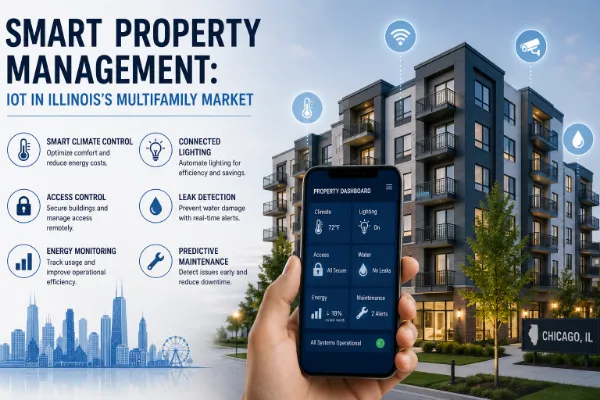
Given Chicago's specific combination of tight vacancy, rising operating costs, older building stock, and a regulatory environment property owners describe as genuinely demanding, the practical smart property technology priorities in this market differ somewhat from a more purely amenity-competition-driven multifamily market:
- Leak detection and plumbing monitoring, given how much of Chicago's building stock predates modern plumbing standards and how costly water damage claims become in a market already managing elevated operating costs.
- Submetering and energy monitoring, supporting both cost control amid rising utility expenses and the kind of usage documentation increasingly relevant given Chicago's regulatory environment around utility billing practices.
- Compliance documentation systems, generating the kind of automated, timestamped record-keeping that reduces legal exposure in a market local property managers specifically describe as one where mistakes can lead to rent refunds, doubled deposits, or legal penalties.
- HVAC monitoring calibrated to Illinois's dual-season extremes, covered in more depth in this site's broader coverage of Illinois commercial building heating and cooling challenges, applied specifically to the mechanical systems common in older Chicago multifamily buildings.
Even with owners holding genuine pricing power in the current market, renter priorities have shifted in ways that still influence technology investment decisions at the margin current Chicago rental market trends specifically point to renters increasingly prioritizing eco-friendly features like smart thermostats and better insulation, alongside flexible lease terms and public working spaces with reliable Wi-Fi access. A tight vacancy environment doesn't eliminate the value of tenant-facing smart technology entirely; it simply means owners can be more selective about which specific technology investments deliver genuine retention and rent-growth value, rather than needing to compete purely on amenity breadth the way an oversupplied market would require.
Institutional investors evaluating Chicago multifamily acquisitions have increasingly focused on the improving fundamentals story described throughout this article a sharp pullback in new supply allowing existing assets to absorb demand and stabilize revenue, supported by Chicago's genuinely diverse employment base spanning finance, healthcare, logistics, and professional services. For owners of existing multifamily assets specifically, this investment community attention adds a further practical reason to prioritize the kind of documented, IoT-driven operational efficiency data covered throughout this article a building with continuous, verifiable energy, maintenance, and compliance monitoring data presents a more attractive and more easily underwritten acquisition target than a comparable property relying purely on historical financial statements without the kind of operational transparency modern institutional buyers increasingly expect.
For a Chicago-area multifamily owner evaluating smart property technology investment in the current market, the practical sequencing should reflect this market's actual conditions rather than a generic national playbook: prioritize leak detection and compliance documentation given the operating cost and regulatory pressures specific to this market, particularly for older building stock, before layering in tenant-facing amenity technology aimed at competitive differentiation a priority ordering that would look different in a market facing genuine oversupply and tenant retention pressure rather than Chicago's current combination of tight vacancy and rising operating costs.
Frequently asked questions
Occupancy reached 94.9% in Q2 2026, well above the market's 10-year historical average of 93.8%, while new construction sits at its lowest level since 2012, with just 1.9% of existing inventory currently under construction.
Older buildings carry aging plumbing infrastructure and non-standard configurations from decades of renovations, making leak detection and structural monitoring particularly valuable compared to newer, standardized construction.
Adaptive reuse, not new construction downtown alone has 806 adaptive reuse units scheduled for 2026 delivery with another 3,921 proposed, representing more than 45% of expected new units over the next two years.
Less so than in oversupplied markets with owners holding genuine pricing power amid tight vacancy, the primary driver is operational efficiency and compliance rather than tenant-facing amenity competition.
Current trends point to renters valuing eco-friendly features like smart thermostats and better insulation, flexible lease terms, and reliable public Wi-Fi, even though owners aren't under the same competitive pressure as an oversupplied market.
Leak detection and compliance documentation systems generally deliver the most immediate value given the market's rising operating costs and demanding regulatory environment, particularly for older building stock, ahead of tenant-facing amenity technology.
Related articles

 Construction & Real Estate