Drive west out of Chicago on I-88 and you'll pass a landscape that's changing faster than almost any other corner of Illinois real estate. Former farmland outside Aurora now hosts some of the largest buildings in the state, and more are on the way, with a hyperscale project even breaking ground in Sangamon County, hundreds of miles from the traditional Chicago-area tech corridor. This is Construction & Real Estate at its most industrial scale, and it's producing a genuinely new category of IoT demand: buildings where the sensors aren't an add-on, they're load-bearing infrastructure for the entire business case.
The state's appeal to hyperscalers, the Metas, Microsofts, and CyrusOnes of the world, comes down to a few overlapping advantages: dense fiber networks already running through the Chicago area, access to ComEd's electrical grid, and large, relatively cheap parcels of land on the metro fringe. DeKalb's Meta facility, operating since 2022, established the template, and CyrusOne followed with a $350 million project in Aurora. By 2025, land and substation capacity near Chicago had tightened enough that development started pushing outward, with CyrusOne's $500 million Sangamon County project marking the first major hyperscale build in central Illinois.
The construction employment numbers alone explain why local governments are paying close attention: DeKalb's Meta site employed more than a thousand union construction workers over its five-year build. That's a genuinely large, IoT-intensive construction project, not a speculative one.
A hyperscale data center is arguably the most sensor-dense construction project a general contractor will ever manage, and that intensity starts well before the building opens.
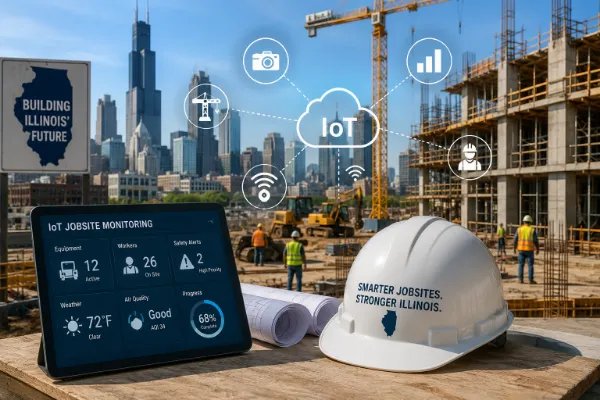
- Jobsite monitoring during construction: Given the scale and multi-year timelines of these builds, connected jobsite sensors tracking equipment location, worker safety zones, and material deliveries are standard practice, not an upgrade. The same connected-jobsite approach used across Illinois's broader commercial construction boom applies here at a larger scale.
- Environmental compliance sensors: Newer projects, including Aurora's, face local ordinances requiring documented noise, water consumption, and energy use studies before and during construction. IoT environmental monitors are how developers generate the ongoing data these ordinances now require, rather than a one-time consultant report.
- Grid interconnection monitoring: Because these facilities draw enormous, often unpredictable loads, ComEd and developers are increasingly instrumenting substations and interconnection points during construction itself, a shift also playing out in broader grid modernization efforts from ComEd and Ameren Illinois, rather than waiting until the facility goes live to start measuring grid impact.
- Cooling system commissioning: Newer facilities, like DeKalb's Edged data center, are being built with waterless cooling systems, which require extensive sensor networks to validate performance before the building is ever occupied.
What makes this a real estate story as much as a technology one is the property tax dynamic. In DeKalb, Meta's subsidiary paid roughly $48.5 million in property taxes across its sites between 2021 and 2024, with the majority flowing to the local school district and funding a new school building. Aurora, by contrast, has taken a more cautious approach, banking its data center revenue into general accounts rather than committing to specific projects, while also enacting new ordinances requiring renewable energy sourcing and formal studies on noise and water use before approval.
That divergence between DeKalb's welcome-the-windfall posture and Aurora's regulate-first approach is becoming a genuine template question for other Illinois municipalities considering a project. Communities weighing a data center proposal are increasingly asking developers to instrument their commitments, not just promise them, which is pushing IoT monitoring requirements into zoning agreements themselves.
The flip side of this boom is that Illinois' data center pipeline is now large enough to genuinely stress the regional grid. Chicago ranks among the top data-center power markets in the country, and organized community opposition has already emerged in places like Pekin over concerns about competing groundwater and aquifer access. Utility-scale interconnection studies, the kind that determine whether a substation can actually support a new facility's draw, are themselves becoming more IoT-instrumented as ComEd works to give developers real-time visibility into available capacity rather than static, outdated estimates.
This is pushing some hyperscalers toward co-located power generation, following early examples like corporate nuclear power purchase agreements, a trend that will only deepen the overlap between data center construction and the state's energy infrastructure planning.
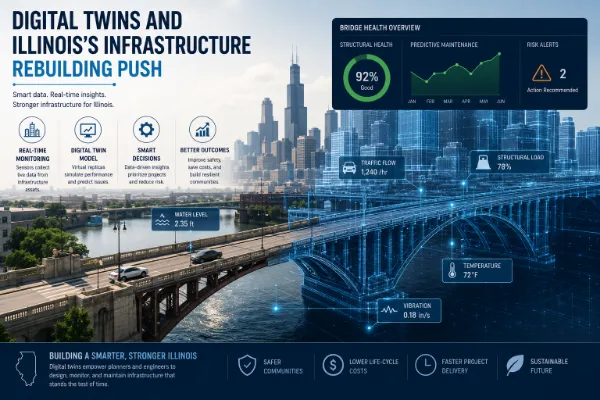
For a general contractor or developer not previously working at hyperscale, the practical entry point isn't necessarily landing a hyperscaler contract directly. It's building the connected-jobsite and environmental-monitoring capability that these projects now require as a baseline, since that same instrumentation is increasingly expected on large commercial and industrial builds generally, including the kind of large-scale modeling covered in this piece on digital twins for Illinois infrastructure, not just data centers. Contractors who can walk into a permit hearing with real sensor data on water use, noise, and construction traffic have a real advantage over ones showing up with projections alone.
Browse more Construction & Real Estate coverage, or see related reporting on Energy & Sustainability as grid capacity becomes a bigger factor in where these projects get built.
Residents in several communities have pushed back hard, citing water use, noise, and rapid, largely invisible growth. Projects that lead with transparent, sensor-verified environmental data during construction, rather than after complaints start, are faring better in permit hearings.
As more projects compete for limited substation capacity, interconnection studies are taking longer and requiring more granular data than in past cycles. Developers who can supply real usage projections backed by monitoring from comparable existing facilities move through this process faster.
Aurora, DeKalb, and other municipalities have taken meaningfully different regulatory approaches, and a statewide framework, the POWER Act, has stalled in the legislature. Developers currently need a jurisdiction-by-jurisdiction compliance strategy rather than a single statewide playbook.
Expect the geographic spread to continue, following CyrusOne's move into Sangamon County, as land and grid capacity near Chicago tighten further. Expect more municipalities to follow Aurora's lead in requiring pre-construction environmental studies backed by ongoing sensor data rather than one-time assessments. And expect the connection between data centers and dedicated power generation, whether nuclear, solar, or battery storage, to deepen as developers look for ways to secure capacity without waiting years for standard grid interconnection.
Frequently asked questions
Dense existing fiber infrastructure, access to ComEd's grid, and available land on the Chicago metro fringe made northern Illinois an early hyperscale hub, and rising land and grid constraints there are now pushing projects into new areas like Sangamon County.
It varies significantly by project size and local tax rates, but Meta's DeKalb facilities generated roughly $48.5 million in property taxes between 2021 and 2024 alone, funding local school construction.
During construction, IoT covers jobsite safety monitoring, environmental compliance tracking for noise and water use, and grid interconnection monitoring, all of which increasingly show up in permit and zoning requirements before a facility ever opens.
Concerns center on water consumption, noise, energy demand's effect on the regional grid, and the pace of largely invisible growth that residents feel wasn't fully explained before approval.
The state passed the Clean and Reliable Grid Affordability Act, directing utilities to build virtual power plant programs and procure significant new battery storage capacity, while some hyperscalers are pursuing dedicated power generation agreements directly.
Related articles

 Construction & Real Estate