Illinois released the largest multi-year infrastructure construction program in state history in October 2025: $50.6 billion over six years, covering fiscal years 2026 through 2031, eclipsing the previous record of $41.4 billion set just a year earlier. That figure sits against a genuinely sobering backdrop Illinois's infrastructure carries an overall C-rating, with deferred maintenance backlogs across the state's road and transit systems reaching $30 billion even before accounting for what this new program aims to address. At this scale and against this kind of backlog, digital twin modeling has become a genuinely practical tool for sequencing and validating infrastructure investment, not just a novelty layered onto individual flagship projects.
Since its original passage in 2019, the broader Rebuild Illinois capital program has invested more than $20.8 billion through its sixth year, improving 21,309 lane miles of highway, 815 bridges, and delivering 1,181 additional safety improvements ranging from routine resurfacing to major interstate and bridge reconstruction. Currently, 74% of Illinois roads and 86% of bridges are rated as acceptable figures that illustrate genuine progress against the state's infrastructure backlog, while also making clear how much work remains ahead under the newly expanded six-year program. Individual flagship projects illustrate the program's actual scale: the $1.3 billion I-80 corridor rehabilitation, including new bridges over the Des Plaines River that began construction in May 2026, represents one of the program's largest single multiyear commitments, with the entire corridor scheduled for completion at the end of 2028.
Managing a $50.6 billion program spanning every Illinois county simultaneously creates a genuinely different planning challenge than a single, isolated infrastructure project sequencing hundreds of individual road, bridge, and transit projects across the state requires understanding how each project interacts with the broader network, since closing or restricting one major corridor for reconstruction directly affects traffic patterns and load distribution on nearby routes, which may themselves be scheduled for construction in an overlapping timeframe. Digital twin modeling, covered in more general terms in this site's broader coverage of infrastructure planning technology, lets IDOT and the broader network of contractors and local agencies involved in a program this size run "what-if" scenario testing on project sequencing before committing to a specific construction schedule modeling how a given corridor closure would actually affect traffic flow across a wider regional network, rather than discovering unexpected congestion or safety problems only after multiple overlapping projects are already underway simultaneously.
IDOT's own recent project history offers a concrete illustration of what disciplined project sequencing and monitoring can deliver at the individual project level: a $65.3 million rehabilitation project on I-255 in the Metro East region was completed six weeks ahead of schedule, saving $10 million in the process, while maintaining worker safety throughout. While this specific project's success reflects broader construction management discipline rather than digital twin technology in isolation, it illustrates the kind of outcome that continuous, data-driven progress monitoring and scenario planning the same fundamental logic behind digital twin modeling can deliver when applied consistently across a program spanning the scale Illinois is now undertaking through 2031.
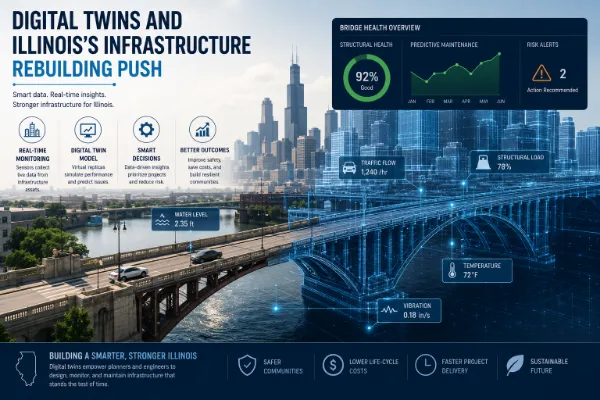
Given that 815 bridges have already received improvements under Rebuild Illinois's first six years, with considerably more bridge work planned under the new $50.6 billion program, bridge-specific digital twin modeling represents a genuinely valuable application distinct from broader corridor-level traffic sequencing. A structural digital twin for an individual bridge continuously updated with sensor data on load, vibration, and structural stress lets engineers validate a bridge's actual remaining service life against its original design specifications, informing whether a specific structure is a better candidate for continued monitoring and incremental repair or for full replacement within the broader program's prioritization sequence. This kind of bridge-specific modeling matters considerably given how directly Illinois's genuinely aging bridge inventory, much of it built decades before this kind of continuous sensor monitoring was technically feasible, needs exactly this kind of individualized, data-driven prioritization rather than a purely age-based or visual-inspection-driven replacement schedule.
Illinois's infrastructure rebuilding push runs in parallel with the state's data center construction boom, covered in more detail in this site's coverage of IoT jobsite monitoring for that sector and the two stories connect more directly than they might initially appear. Grid interconnection capacity, the primary bottleneck shaping where and how quickly data center projects can proceed, depends partly on the same underlying electrical transmission infrastructure that Illinois's broader infrastructure investment touches, even though ComEd's grid infrastructure itself sits outside IDOT's direct road and bridge program. Digital twin modeling applied to regional infrastructure planning increasingly needs to account for this kind of cross-sector interaction a major new data center campus's power demand affects regional grid planning in ways that a purely road-and-bridge-focused digital twin model wouldn't capture on its own, arguing for infrastructure planning models that increasingly span traditional transportation, utility, and large-scale commercial development planning simultaneously rather than treating each as an entirely separate modeling exercise.
Beyond bridge and corridor rehabilitation in the Chicago region, Rebuild Illinois's expanded scope includes genuinely significant new highway capacity work downstate the expansion of I-57 between West Frankfort and Benton in Franklin County added 27 miles of six-lane highway, with work continuing on additional segments between Marion and I-24 and through the Rend Lake area. This kind of new-capacity highway expansion, distinct from the rehabilitation-focused work more common in the older Chicago-area network, benefits from a genuinely different digital twin application: modeling projected traffic growth and land use change along a newly expanded corridor to validate that the added capacity will actually match anticipated demand over its multi-decade design life, rather than modeling existing infrastructure condition and remaining service life the way bridge and rehabilitation-focused digital twins primarily do.
For Illinois communities anticipating infrastructure work under the new six-year program, and for contractors bidding into this pipeline, digital twin-informed sequencing offers a genuinely practical benefit worth understanding: better modeling of how overlapping projects affect regional traffic and safety conditions should translate into fewer surprise conflicts between simultaneously scheduled projects, and potentially faster overall program delivery given how directly the I-255 example above illustrates the value of disciplined project execution at scale. Communities and contractors engaging with IDOT on specific projects within the broader program should expect increasing use of this kind of scenario-based planning tool as the six-year program moves from initial announcement into active, overlapping construction across the state's 102 counties simultaneously.
Frequently asked questions
The state released a $50.6 billion, six-year program covering fiscal years 2026 through 2031 in October 2025, the largest multi-year infrastructure program in state history, eclipsing the previous $41.4 billion record.
Illinois's infrastructure carries an overall C-rating with a $30 billion deferred maintenance backlog across road and transit systems, even after more than $20.8 billion in improvements delivered through Rebuild Illinois's first six years.
Sequencing hundreds of overlapping projects across every Illinois county requires understanding how individual project closures affect regional traffic and load distribution, which digital twin scenario modeling can validate before construction schedules are finalized.
Continuously updated structural sensor data helps validate a bridge's actual remaining service life against its original design, informing whether a specific structure is better suited to continued monitoring or full replacement within the broader program.
Grid interconnection capacity, the primary bottleneck for data center construction, depends partly on the same underlying regional electrical infrastructure that broader state infrastructure planning increasingly needs to model alongside traditional roads and bridges.
The $65.3 million project was completed six weeks ahead of schedule and saved $10 million while maintaining worker safety, illustrating the kind of outcome disciplined, data-driven project management can deliver at scale.
Related articles

 Construction & Real Estate