Every acre of Illinois cropland already does something valuable most farmers never get paid for: it pulls carbon out of the air and locks it into the soil. That's been true for as long as corn and soybeans have grown here. What's changed in the last few years is the ability to measure it cheaply enough, and prove it convincingly enough, that a buyer will actually write a check for it. That shift is being driven less by policy and more by a quiet category of hardware: IoT soil sensors that turn a vague sustainability claim into a verifiable data stream.
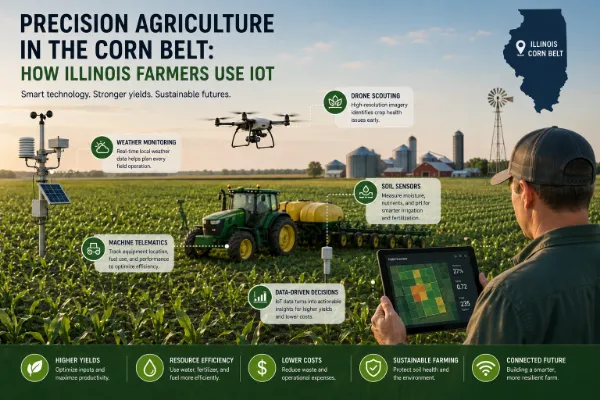
This falls under Agriculture IoT, and it's one of the more financially interesting corners of it, because unlike most ag-tech investments, carbon monitoring isn't primarily about yield. It's about getting paid for something the farm was already doing. It builds directly on the sensor foundations covered in this guide to precision agriculture across the Corn Belt.
Illinois sits in the sweet spot for agricultural carbon programs. Corn Belt soils, including much of central and northern Illinois, offer some of the strongest sequestration potential in the country, with annual revenue estimates in the range of fifteen to thirty-five dollars per acre for growers who adopt practices like no-till and cover cropping. Premium, directly verified carbon credits have traded as high as fifty dollars each in recent years, and some private buyers have paid even more for high-confidence, well-documented projects.
The state has been building this market for longer than most people realize. Illinois launched one of the country's first state-backed agricultural carbon trading efforts through a program connecting farmers to the old Chicago Climate Exchange, decades before "carbon credit" became a mainstream farm-country phrase. Today, that early groundwork has been replaced by a much larger set of private buyers. Grain companies like ADM run their own regenerative agriculture programs that pay per-bushel premiums tied to emissions scoring, and agtech firms like Indigo Ag broker soil carbon credits directly to corporate buyers, with some contracts paying in the sixty-to-eighty-dollar range per credit.
The obstacle that kept carbon markets small for years wasn't farmer interest. It was verification cost. Traditional soil sampling, where a technician drives to a field, pulls core samples by hand, and ships them to a lab, is slow and expensive enough that it eats deeply into whatever a farmer would earn from the credit itself. That's the exact problem IoT sensor networks solve.
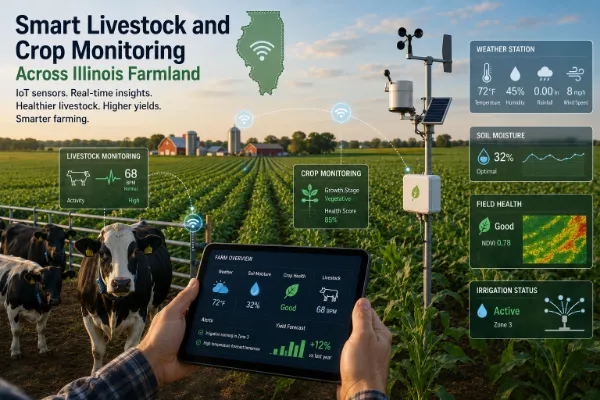
A modern soil carbon monitoring setup typically combines a few connected components, many of which overlap with the equipment telemetry already covered in this look at livestock and crop monitoring across Illinois farmland:
- In-ground soil probes that continuously track organic matter proxies, moisture, and temperature at multiple depths, replacing a once-a-year manual sample with a running dataset.
- Satellite and remote sensing overlays that estimate vegetation health and residue cover across a whole field between physical checks, cutting down how often a technician needs to visit.
- Connected equipment data from planters and tillage implements that automatically logs whether a no-till or cover crop practice was actually followed, since carbon buyers increasingly want practice verification, not just self-reported paperwork.
Combined, this data feeds into a measurement, reporting, and verification engine, the "MRV" layer that carbon buyers rely on to certify a credit is real. The sensor data doesn't replace the occasional lab sample entirely, but it dramatically reduces how many are needed, which is what has finally made mid-size row-crop operations viable participants rather than just the largest farms.
Picture an 1,800-acre corn and soybean operation in the central part of the state that's been running reduced tillage for years but never bothered to enroll in a carbon program because the paperwork and sampling costs looked like they'd eat the payment. With soil moisture and temperature probes already in place for irrigation and planting decisions, and a data-logging kit added to the planter, that same farm can now generate the continuous field-level evidence a carbon program wants, largely as a byproduct of decisions it was already making for agronomic reasons. That's the pattern showing up across the state: carbon revenue riding on top of sensor infrastructure that was justified by something else first.
The direct payment is only part of the case. Data-driven monitoring is also becoming a factor in how lenders view a farm's risk profile. Illinois agricultural lenders have started treating verified sustainability data, things like satellite crop monitoring and carbon tracking, as a signal of lower risk and stronger long-term planning, which can influence loan terms separately from the carbon payment itself. In an environment of tight margins and volatile input costs, that secondary benefit matters almost as much as the credit revenue.
There's a real trade-off to weigh, though. Most carbon contracts run ten to twenty years, and buyers typically want continuous practice compliance for the life of the agreement, with penalties or clawbacks if a farmer reverts to conventional tillage partway through. Before enrolling, it's worth clarifying who legally owns the credits generated, since some aggregator contracts are structured so the company, not the farmer, retains long-term rights to the carbon asset.
Carbon credit payments typically don't arrive until two to four years after enrollment, since buyers need multiple growing seasons of verified data before certifying a credit. Farmers need to be able to carry the cost of any practice changes during that gap.
A single probe cluster can't represent an entire quarter-section field, especially across Illinois's varied glacial-till soils. Programs that skimp on sensor density tend to produce weaker, more disputable carbon estimates, which buyers pay less for.
Carbon agreements are legal documents with real long-term land-use implications, not simple enrollment forms. Reviewing credit ownership, exit penalties, and data-sharing terms with someone who understands agricultural contracts before signing matters more here than in almost any other ag-tech decision.
Expect three things to keep shifting the economics in farmers' favor over the next few years. First, sensor and satellite verification costs keep falling, which should push more of the credit's value back to the farmer rather than the aggregator. Second, corporate demand keeps growing as more companies commit to supply-chain emissions targets, giving Illinois grain buyers, not just food and beverage brands, a reason to source from verified low-carbon acres. Third, blockchain-based credit registries are starting to appear as a way to make credit ownership and retirement more transparent, which should reduce the double-counting concerns that have made some corporate buyers cautious.
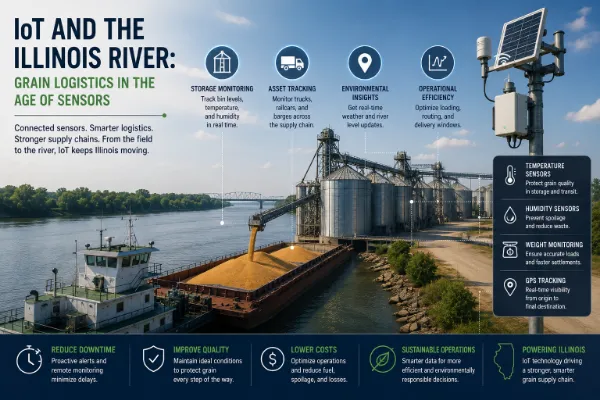
None of this requires an Illinois farm to change what it grows. It requires treating the soil data that's often already being collected for irrigation or planting decisions as a second asset, one with its own buyer, its own price, and its own paperwork. Once that data leaves the field, it also feeds into the broader grain logistics tracking along the Illinois River that increasingly documents a crop's full journey to buyer.
For related coverage, see this piece on Illinois' rural broadband gap, which affects how reliably sensor data reaches the cloud from remote fields, or browse more Agriculture IoT coverage.
Frequently asked questions
Estimates for the Corn Belt, including Illinois, generally run fifteen to thirty-five dollars per acre annually for adopting practices like no-till and cover cropping, though premium, directly verified credits from some private buyers have paid considerably more per credit.
Most programs require adopting or continuing practices like reduced tillage, cover crops, or nitrogen management, and proving those practices were followed, which is exactly what sensor and equipment data is used to verify.
Most programs require two to four years of verified practice data before issuing the first payment, since buyers need multiple seasons of evidence before certifying a credit as real.
Often yes, in part. Existing moisture and temperature probes contribute useful baseline data, but most carbon programs also want equipment-level practice verification and periodic lab sampling on top of what irrigation sensors alone provide.
This varies by contract and is one of the most important terms to check before signing. Some aggregators retain ownership and resell the credits to corporate buyers, while others structure agreements so the farmer retains and sells credit rights directly.
Related articles

 Agriculture IoT