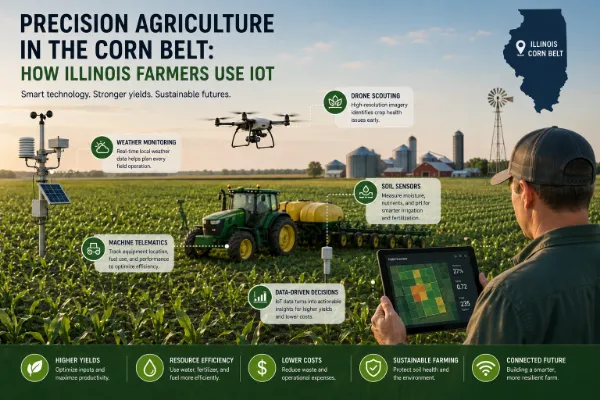
"Farm operations are evolving into powerful data engines," Drew Harmon, a Midwest technical agronomist at Valent BioSciences a biological and biostimulant company headquartered in Illinois told the Illinois Soybean Association heading into the 2026 growing season. That framing captures something genuinely accurate about where Illinois row-crop agriculture actually stands: precision agriculture adoption has moved well past early pilot programs, concentrating heavily in exactly the large-scale corn and soybean systems that define the Corn Belt, with Illinois sitting at the geographic and institutional center of that transformation.
John Deere operates its own Technology Innovation Center in Champaign, Illinois, which hosted the University of Illinois Center for Digital Agriculture's Precision & Digital Agriculture Hackathon in March 2026 a three-day event bringing together students, researchers, and startups to build sensor, AI, drone, and robotics applications addressing climate pressure, soil degradation, and food demand challenges. This isn't incidental geography: national data on precision agriculture adoption consistently shows the technology's leading edge clustering in the Midwest specifically, with states running large-scale corn and soybean systems reporting the highest adoption rates in the country. Illinois's position at the center of both the physical Corn Belt and the institutional infrastructure supporting precision agriculture research the University of Illinois's Center for Digital Agriculture alongside Deere's own dedicated innovation facility gives the state a genuinely unusual concentration of both practical farmer adoption and the research and development infrastructure driving the technology's continued evolution.
John Deere's See & Spray technology, which uses computer vision to distinguish crops from weeds and apply herbicide only where actually needed rather than blanket-spraying an entire field, has delivered an average 59% reduction in herbicide usage across corn, soybean, and cotton operations. In 2024 alone, more than 1 million acres were treated using the technology, with farmers reporting not just the expected chemical savings but an additional 3 to 4 bushels per acre yield increase, attributed to crops experiencing less chemical stress than they would under traditional blanket application. This kind of measurable, dual-benefit return lower input costs alongside a genuine yield gain is a significant part of why early adopters report reaching return on investment faster than initially expected, a genuinely compelling combination for farmers weighing a real capital investment against commodity price volatility.
Illinois farmers were among the first in the country to gain access to CropVoice Whole Farm, a crop disease detection system built on genetically engineered plants branded InnerSoy and InnerCorn that emit a detectable fluorescence signal when infected, allowing the system to confirm an active infection before visible symptoms appear in the field. The technology, named one of TIME's Best Inventions of 2024 and backed by industry partners including John Deere, sends weekly scouting reports and real-time alerts when an active infection is detected near a farmer's fields, paired with a 24/7 agronomy dashboard giving farmers continuous access to field-level disease risk information. This represents a genuinely different category of precision agriculture technology than equipment-mounted sensors like See & Spray rather than optimizing an input application process, CropVoice fundamentally changes when a farmer even knows a problem exists, catching disease pressure during the window when fungicide intervention is still most effective rather than after visible crop damage has already occurred.
Underlying much of this individual technology is the John Deere Operations Center, a platform specifically designed to connect data from fields and machines back to farm operators and their outside advisers letting a grower share yield data directly with a seed representative or receive prescription recommendations wirelessly from an agronomist, while simultaneously providing real-time insight into machine performance and equipment health. This connective layer matters because it turns individual precision agriculture tools like See & Spray and CropVoice from standalone point solutions into components of a broader, integrated farm data ecosystem a farmer isn't just collecting disease detection data or herbicide application data in isolation, but feeding both into the same operational platform that also manages equipment health and agronomic advisory relationships.
A University of Illinois Department of Agricultural and Consumer Economics analysis published in January 2026 identified a genuinely important constraint on continued precision agriculture adoption: the specialized farm service technician workforce needed to install sensors, calibrate controllers, troubleshoot communication networks, and maintain increasingly complex farm equipment. These technicians, typically employed through equipment dealerships affiliated with manufacturers like John Deere, Case New Holland, and AGCO, represent a genuinely constrained labor pool relative to the pace of precision technology adoption meaning the actual rate at which Illinois farmers can deploy and maintain new precision agriculture technology increasingly depends on dealership technician availability as much as on farmer demand or technology cost, a supply-side constraint that's easy to overlook when discussing precision agriculture purely in terms of farmer adoption decisions.
It's worth understanding how See & Spray, CropVoice, and the John Deere Operations Center actually work together on a real Illinois farm rather than as three separate, unrelated technology investments. A farmer running See & Spray-equipped sprayers benefits from CropVoice's early disease detection specifically because catching an infection days before visible symptoms appear gives that same targeted-application equipment a genuine window to respond with a precisely calibrated fungicide application, rather than either missing the treatment window entirely or falling back to a less efficient blanket application once symptoms have already spread. The Operations Center then aggregates data from both systems alongside broader machine performance data, giving a farmer and their agronomic adviser a single, unified view of the season's crop health and equipment performance rather than three disconnected data streams to reconcile manually.
For an Illinois farmer evaluating precision agriculture investment, the practical sequencing should account for both the technology's genuine, documented return on investment and the realistic technician support availability in a specific area a farm operation in a region well-served by a major equipment dealership's technician team faces a genuinely different implementation timeline than one further from established dealer support infrastructure. Given how directly technologies like See & Spray and CropVoice depend on connectivity and ongoing calibration to function correctly, farmers should factor dealer technician relationship and support availability into their technology adoption planning as seriously as the upfront technology cost itself.
Frequently asked questions
John Deere operates its own Technology Innovation Center in Champaign, and the University of Illinois Center for Digital Agriculture drives active research, giving the state an unusual concentration of both farmer adoption and technology development infrastructure.
An average 59% reduction in herbicide usage across corn, soybean, and cotton operations, with more than 1 million acres treated in 2024 alone, alongside an additional 3 to 4 bushels per acre yield increase.
A crop disease detection system using genetically engineered plants that emit a fluorescence signal when infected, letting farmers confirm active infection before visible symptoms appear, named one of TIME's Best Inventions of 2024.
It connects data from fields and machines back to farm operators and advisers, letting growers share yield data with seed representatives or receive wireless prescriptions from agronomists while monitoring equipment health.
A University of Illinois analysis identified a constrained farm service technician workforce, typically employed through equipment dealerships, as a genuine bottleneck on the pace of new technology installation and maintenance.
Realistic dealer technician support availability in their specific area, given how directly these technologies depend on ongoing calibration and connectivity to function correctly.
Related articles

 Agriculture IoT