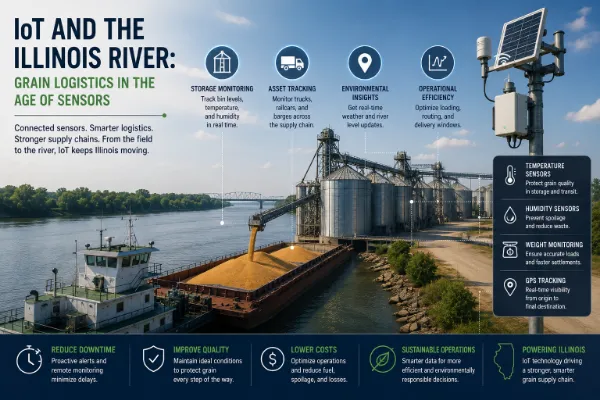
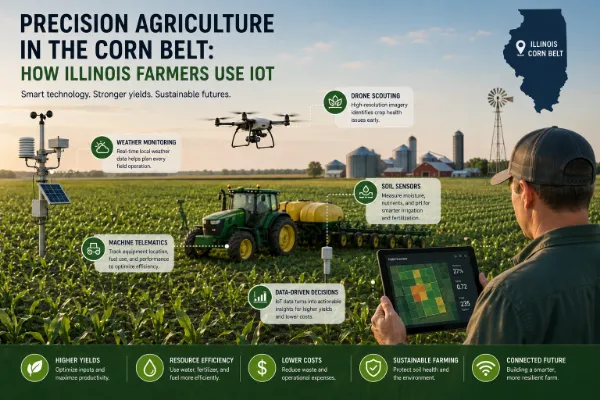
Illinois farmland is overwhelmingly corn and soybean country, and the precision agriculture technology covered in more detail elsewhere on this site reflects that dominant reality. But Illinois also carries a genuine, if secondary, livestock sector hog and cattle operations woven throughout the state's agricultural landscape and the IoT monitoring technology reshaping livestock management nationally applies directly to these Illinois operations, working alongside, rather than separately from, the same row-crop monitoring infrastructure covered in this site's broader precision agriculture coverage.
The single most consequential finding driving current livestock IoT adoption is genuinely simple to state: research confirms that sensor-detected behavioral changes in cattle can appear four to six days before clinical signs of respiratory disease become visible to a farmer conducting a routine visual check. That lead time matters enormously in practice respiratory disease caught four to six days earlier means intervention before a sick animal has infected pen-mates, before weight loss and reduced feed efficiency compound, and before treatment costs escalate from a straightforward early intervention to a more intensive, expensive response. For Illinois livestock operations managing genuinely tight margins against feed and input costs, this kind of early detection window represents one of the more directly quantifiable returns available from any livestock technology investment.
Modern livestock IoT deployments typically combine several sensor categories working together rather than any single device delivering comprehensive monitoring on its own. Wearable sensors and smart tags mounted on a collar or ear, or in some cases as an ingestible bolus track heart rate, rumination patterns, and GPS location, enabling early detection of disease, estrus, and heat stress simultaneously through the same physical device. Barn environmental monitoring systems track temperature, humidity, and gas concentrations including methane and carbon dioxide, addressing both animal welfare conditions and, increasingly, the kind of emissions monitoring that's become a genuine sustainability and regulatory consideration for larger livestock operations. Virtual fencing systems, using GPS collars paired with app-based geofencing, let operations contain cattle without physical fencing infrastructure at all reducing fencing costs while supporting more flexible rotational grazing management than a fixed fence line would allow.
Effective livestock IoT deployment depends on four distinct layers working together rather than any single device delivering value in isolation: sensing hardware on and around the animal, connectivity moving data from the sensor to a usable dashboard, analytics applying rules and thresholds to filter raw data into genuinely actionable, prioritized alerts, and the actual on-farm action a crew takes in response the triage, confirmation check, treatment, and outcome logging that closes the loop and improves the system's future accuracy. A common and genuinely costly misconception worth avoiding directly: more raw sensor data doesn't automatically translate into better outcomes, and unfiltered data flooding a farm crew with constant, unprioritized alerts tends to produce exactly the kind of alert fatigue that undermines a monitoring system's real value, regardless of how sophisticated the underlying sensor hardware actually is.
Illinois livestock operations benefit from the same broader agricultural technology ecosystem covered in more depth in this site's coverage of Corn Belt precision agriculture the connectivity infrastructure, dealer technician support networks, and general agricultural IoT familiarity that's developed substantially around the state's dominant row-crop sector increasingly extends into livestock-specific applications as well. This matters practically: an Illinois livestock operation evaluating sensor technology investment benefits from a technology support ecosystem that's already reasonably mature for agricultural IoT generally, even though the specific livestock sensor products themselves come from different vendors than the crop-focused precision agriculture tools covered elsewhere on this site.
Barn environmental and gas concentration monitoring in Illinois livestock facilities serves a genuinely dual purpose worth understanding clearly: it directly supports animal welfare and productivity by maintaining conditions within an appropriate range for the specific species and production stage, while simultaneously generating the kind of documented emissions data that's become increasingly relevant given growing regulatory and market attention to agricultural methane and other livestock-related emissions. Continuous, sensor-based monitoring generates a genuinely more defensible documentation trail for this second purpose than periodic manual assessment would provide a consideration that's likely to grow in importance for Illinois livestock operations as emissions reporting and sustainability documentation expectations continue evolving across the broader agricultural sector.
Before committing to a specific livestock sensor platform, Illinois producers should clarify directly who actually owns and can access the resulting animal health and productivity data, given how much of this information could carry genuine value to input suppliers, processors, or future technology vendors beyond the farm's own operational use. This mirrors a broader data ownership consideration already familiar to Illinois row-crop farmers using platforms like the John Deere Operations Center covered in more detail elsewhere on this site, and livestock producers evaluating a new sensor platform should ask the same kind of direct questions about data portability and ownership rights before committing to a specific vendor's ecosystem.
For a mid-size Illinois livestock operation evaluating this technology, realistic adoption typically starts narrower than a comprehensive, whole-herd deployment prioritizing wearable health monitoring on breeding stock or a specific high-value production group first, given the genuinely elevated cost of a health or reproductive event in these animals relative to the broader herd, before expanding to environmental monitoring and virtual fencing as budget and demonstrated results support further investment. This phased approach mirrors the same disciplined, criticality-first sequencing covered in more depth in this site's broader coverage of Illinois manufacturing IoT deployment strategy starting narrow, demonstrating measurable value, and expanding deliberately rather than attempting comprehensive coverage from day one.
Livestock sensor systems depend on reliable data connectivity to actually function, and Illinois producers should evaluate which connectivity option cellular, LoRaWAN, satellite, or edge devices processing data locally before transmission genuinely fits their specific operation's location, given the broadband access gaps covered in more detail in this site's coverage of Illinois's rural connectivity challenges. A livestock operation in a well-connected area near a larger town faces a genuinely different technology selection process than one in a more remote part of the state, where a LoRaWAN or satellite-based system built for lower-bandwidth, longer-range transmission may prove more reliable than a cellular-dependent platform assuming consistent signal strength that isn't actually available on site.
Frequently asked questions
Research confirms sensor-detected behavioral changes can appear four to six days before clinical signs of respiratory disease become visible to a farmer conducting a routine visual check.
Devices mounted on collars, ear tags, or as ingestible boluses track heart rate, rumination patterns, and GPS location, enabling simultaneous detection of disease, estrus, and heat stress through a single device.
GPS collars paired with app-based geofencing contain cattle without physical fence infrastructure, reducing fencing costs while supporting more flexible rotational grazing management.
Unfiltered data flooding a farm crew with constant, unprioritized alerts produces alert fatigue that undermines a monitoring system's real value, regardless of how sophisticated the underlying sensor hardware is.
It supports animal welfare and productivity by maintaining appropriate conditions, while simultaneously generating documented emissions data increasingly relevant given growing regulatory and market attention to livestock emissions.
Prioritizing wearable health monitoring on breeding stock or a high-value production group first, given the elevated cost of a health or reproductive event in these animals, before expanding to broader herd and environmental monitoring.
Related articles

 Agriculture IoT