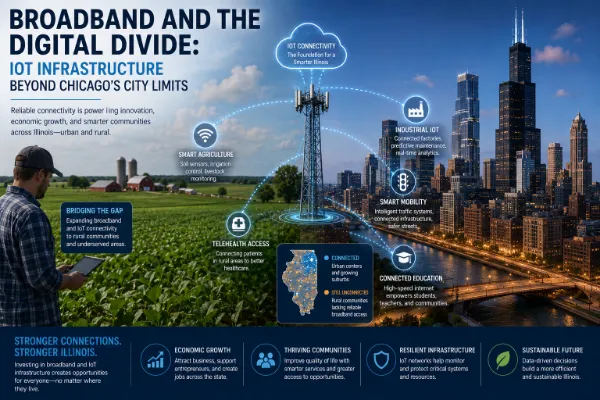
Every smart city, smart agriculture, and connected infrastructure topic covered elsewhere on this site depends on a single underlying assumption: that reliable internet connectivity actually exists at the physical location where a sensor, camera, or monitoring device needs to transmit its data. That assumption breaks down considerably once you leave Illinois's major metro areas an estimated 40% of Illinois farmers are underserved or completely unserved by reliable internet access, a gap that doesn't just limit Netflix streaming in rural communities, it directly constrains how much of the IoT technology covered throughout this site is actually deployable outside the state's urban core.
Governor Pritzker's Connect Illinois initiative directs a total of $420 million toward broadband expansion, split between a $400 million grant matching program and a $20 million capital investment in the Illinois Century Network, the state's dedicated high-speed backbone serving K-12 schools and higher education institutions. The program's matching structure requires internet service providers to contribute alongside state grant funding, a mechanism designed to leverage the state's initial investment into a larger total buildout bringing the effective total closer to $800 million once private matching commitments are included. Beyond the state program, Illinois has drawn on more than $1.3 billion in federal support through the American Rescue Plan Act and Infrastructure Investment and Jobs Act specifically for the Connect Illinois Broadband Grant Program and related digital equity initiatives, with a single 2024 southern Illinois announcement alone accounting for $1.6 billion in combined state and federal grant funding for regional fiber deployment.
Connect Illinois funding follows a deliberate formula prioritizing the areas with the most severe connectivity gaps first: unserved locations, defined as those below 25/3 Mbps, receive priority, followed by underserved locations below 100/20 Mbps, and finally community anchor institutions needing at least 1/1 Gbps service. This tiered approach reflects a genuine policy judgment that the areas with literally no functional broadband access deserve funding priority over areas with merely inadequate service a distinction that matters considerably for how quickly different parts of rural Illinois actually see infrastructure investment arrive, since a community with zero broadband access moves ahead of a community with slow but existing service in the funding queue.
The Illinois Farm Bureau has been direct about the practical stakes of this gap: reliable, affordable broadband is described as a necessity not just for quality of farm family life, but for the success of modern agriculture specifically precision agriculture technology, covered in more detail in this site's broader coverage of Illinois farming IoT, depends entirely on continuous connectivity to transmit soil sensor data, guide GPS-based equipment, and support the kind of real-time yield and irrigation monitoring that's become standard practice on well-connected farms elsewhere in the country. A farm operation without reliable broadband access is functionally locked out of a meaningful share of the precision agriculture technology that's increasingly considered standard practice, regardless of whether the farm can otherwise afford the equipment connectivity, not capital, becomes the binding constraint.
Illinois's broadband strategy has also addressed a genuinely distinct barrier beyond physical infrastructure: adoption and digital literacy. The Illinois Office of Broadband, working with the Illinois Broadband Lab, received a $700,000 federal grant to develop a statewide "digital navigator" network trained personnel helping residents actually enroll in available broadband programs and develop the basic digital skills needed to use the connectivity once it's available. This matters because infrastructure investment alone doesn't guarantee adoption: a rural household or small business gaining access to a new fiber connection still needs to understand how to use it effectively, and a state broadband strategy that funds only the physical buildout without addressing this adoption gap risks leaving meaningful connectivity potential unrealized even after the infrastructure itself is technically available.
It's worth understanding that Illinois's broadband buildout sits within a broader, actively shifting federal funding environment. The national BEAD program, carrying $42.45 billion in federal funding, remains the largest piece of the current broadband buildout nationally, with states actively signing subgrant agreements with ISPs, electric cooperatives, and municipalities throughout 2026. Separately, USDA's ReConnect program, which distributed more than $2.6 billion in earlier rounds including grants supporting rural southern Illinois cooperatives, had no active application window as of early 2026, with future rounds likely reshaped by how they overlap with BEAD's larger, more recently prioritized funding stream. For Illinois communities and IoT deployment planning specifically, this means the broadband funding landscape remains genuinely dynamic a rural area currently unserved shouldn't assume the current funding mechanism will remain the primary pathway to connectivity indefinitely, given how actively federal broadband program structures have continued evolving.
It's worth noting that Illinois's digital divide isn't purely a rural-versus-urban story Connect Illinois's equity-driven framing specifically identifies disparities in broadband access and adoption within Black and brown communities across the state, including within otherwise well-connected metro areas, as a distinct priority alongside the more commonly discussed rural connectivity gap. This matters for how IoT deployment planning should think about connectivity assumptions even within Chicago and other larger Illinois cities: strong citywide broadband statistics can mask meaningful within-city disparities in actual household adoption, meaning a smart city or connected health monitoring program assuming universal connectivity across an entire urban service area may still be leaving a meaningful share of residents functionally excluded, even in a city with generally strong infrastructure.
For any organization planning IoT deployment in Illinois outside the Chicago metro area whether agricultural technology, rural healthcare remote monitoring, or smart utility infrastructure in a smaller downstate city connectivity availability needs to be verified at the specific deployment site before committing to a sensor technology choice, rather than assumed based on general regional broadband statistics. A county with strong aggregate broadband statistics can still contain individual unserved pockets, particularly in agricultural areas where farm operations sit meaningfully further from existing fiber infrastructure than the county seat or nearby small city. Organizations planning IoT deployment in these areas should factor in both the current Connect Illinois funding priority tiers, which indicate where infrastructure investment is most likely arriving soonest, and cellular or satellite backup connectivity options for sensor deployments that can't wait for fiber buildout to reach a specific rural location.
Frequently asked questions
The state program directs $420 million, including $400 million in grant matching funds and $20 million for the Illinois Century Network, with ISP matching commitments bringing the effective total closer to $800 million.
An estimated 40% of Illinois farmers are underserved or completely unserved by reliable internet access, directly limiting adoption of precision agriculture technology that depends on continuous connectivity.
Funding follows a formula prioritizing completely unserved locations (below 25/3 Mbps) first, followed by underserved locations (below 100/20 Mbps), and then community anchor institutions needing gigabit-level service.
A statewide network of trained personnel, funded through a $700,000 federal grant, helping residents enroll in available broadband programs and develop the digital skills needed to actually use new connectivity once it's available.
Not necessarily in its current form the $42.45 billion national BEAD program remains active through 2026, while USDA's ReConnect program had no active application window as of early 2026, with future federal broadband funding structures likely to keep evolving.
A county with strong aggregate broadband statistics can still contain individual unserved pockets, particularly in agricultural areas farther from existing fiber infrastructure, making site-specific connectivity verification necessary before committing to a sensor technology approach.
Related articles

 Smart Cities