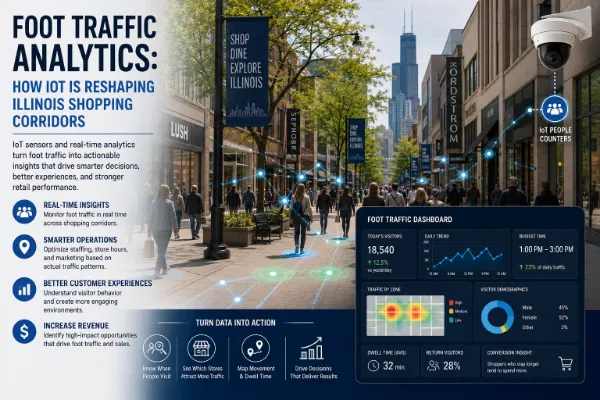
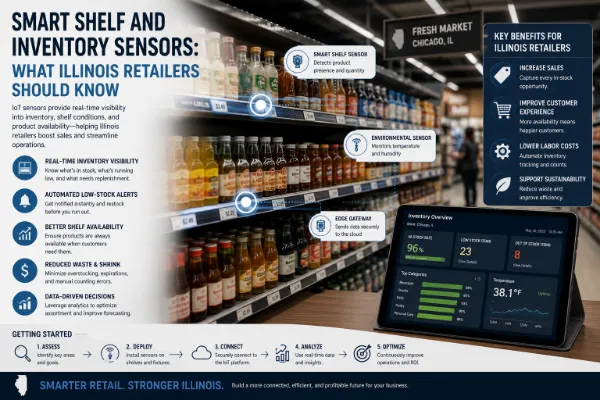
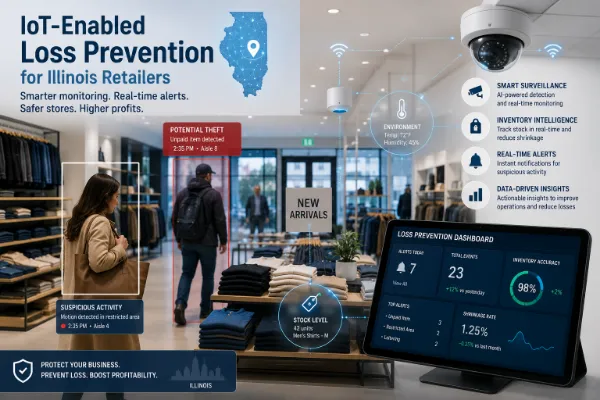
The retail IoT story in most of Illinois has been about incremental efficiency: smart shelf sensors that flag low stock, foot traffic analytics that inform staffing, cameras that support loss prevention. The next wave is a bigger structural bet, one that changes what a store building is actually for. This is where Retail IoT is heading in 2026, and Illinois grocers and retail chains, sitting in a state with genuine urban density in Chicago and a sprawling suburban and downstate footprint everywhere else, are a useful test case for where this technology actually makes sense and where it's still mostly hype.
Checkout-free retail and micro-fulfillment get talked about together constantly, but they solve different problems and require different investments.
Checkout-free retail uses cameras, sensors, and AI to track what a shopper physically picks up in a store, automatically charging their account when they walk out, no register, no scanning, no line. Micro-fulfillment is almost the opposite use case: it's about assembling an online order fast, using automation to pick items from a compact, highly organized inventory system, often built directly into or behind an existing store, so a delivery or pickup order can be ready in minutes rather than hours.
Both rely on connected sensors and real-time inventory data. Both are reshaping what physical retail space is used for. But a store investing in one doesn't automatically get the other, and conflating them leads to muddled planning.
The clearer, faster-maturing business case right now is micro-fulfillment. Major chains have moved well past pilot stage: one national grocer's automated in-store micro-fulfillment centers now process a majority of that company's digital grocery order volume, a dramatic jump from earlier projections that put the technology's market share in the low single digits just a couple of years ago. The core value proposition is straightforward and well-documented, with faster delivery windows measured in hours instead of days cutting cart abandonment rates significantly, since customers are far less likely to abandon an order when they can see a genuinely fast delivery window at checkout.
A typical micro-fulfillment center runs ten to fifty thousand square feet, small enough to fit inside or adjacent to an existing store, which is exactly why Illinois grocers with an established store footprint in Chicago and its suburbs are well positioned to add this capability without a costly new real estate search. One national grocery chain's Chicago-area pilot, built into an existing store's backroom, lets shoppers order items via in-store QR codes that aren't even part of the store's normal specialty assortment, with orders prepared within minutes.
Checkout-free retail has had a rockier path to maturity. Early standalone cashierless store concepts have struggled or shut down entirely, and the market has shifted meaningfully toward hybrid models, where major retailers integrate AI-powered checkout technology into existing store formats rather than betting on a fully autonomous store from scratch. That's a more conservative, lower-risk path for an Illinois retailer to consider than building a dedicated checkout-free concept store.
There's also a genuine privacy tension worth taking seriously before investing. Checkout-free technology depends heavily on continuous camera tracking and, in some implementations, facial recognition, and that's drawn increasing regulatory scrutiny. Illinois retailers in particular need to think carefully about this given the state's Biometric Information Privacy Act, covered in more detail in this piece on HIPAA and Illinois's biometric privacy law, one of the strictest biometric privacy laws in the country, which creates real legal exposure for any system that captures and processes biometric identifiers without proper consent and disclosure.
A newer development worth watching is the integration of conversational AI directly into the shopping and fulfillment pipeline. Major retail partnerships now let shoppers build a digital cart and complete a purchase through a chatbot interface, and delivery platforms have launched tools that convert a photo of a handwritten shopping list into an actual digital cart automatically. For Illinois retailers running micro-fulfillment operations, this front-end convenience layer is what actually drives the order volume that makes the backend automation investment pay off. A fast fulfillment center doesn't help much if customers still find placing the order itself cumbersome.
Consider a regional Illinois grocery chain with a dozen stores across the Chicago suburbs, watching larger national competitors roll out same-day delivery windows the regional chain can't currently match. Rather than attempting a full checkout-free pilot, which carries real privacy compliance risk under Illinois law and a less proven return, the chain's more defensible move is converting underused backroom space in its two or three highest-volume stores into compact micro-fulfillment operations, paired with RFID-based inventory tracking that gives real-time visibility into stock levels without manual counting. That combination directly addresses the same-day delivery gap competitors are winning on, without the added legal exposure of biometric tracking.
A serious micro-fulfillment buildout is a major operational commitment, not something to treat as a low-cost pilot. The capital expenditure for automation, robotics, and space conversion is significant enough that most Illinois retailers need a clear volume projection before committing, not just a general belief that faster delivery will help.
Any checkout-free system relying on facial recognition or other biometric identifiers needs to be evaluated against Illinois's Biometric Information Privacy Act before deployment, not after a complaint or lawsuit forces the issue. This is a materially higher compliance bar than many other states require.
Both technologies need to coexist with a store's existing staff, checkout lanes, and inventory systems during a transition period, and poorly planned integration can create more operational friction than the technology solves, at least initially.
Expect the hybrid model, AI checkout tools layered into existing store formats, to keep winning over standalone cashierless concepts, since it carries less capital risk and lets retailers test the technology without betting an entire store format on it. Expect RFID-enabled inventory systems to become a near-standard companion to any serious micro-fulfillment investment, given their documented improvements in checkout efficiency and inventory accuracy over barcode-based systems. And expect Illinois's biometric privacy law to remain a genuine differentiator in how cautiously the state's retailers approach camera-heavy checkout-free technology compared to retailers in states without similar protections.
Browse more Retail IoT coverage, including related guides to smart shelf and inventory sensors and IoT-based loss prevention for Illinois retailers.
Frequently asked questions
Checkout-free retail uses sensors and AI to let in-store shoppers skip the register entirely, while micro-fulfillment uses automation to assemble online orders quickly from a compact inventory system, often built into an existing store. They're separate technologies solving different problems.
Standalone cashierless stores have had mixed results, and the market is shifting toward hybrid models that integrate AI checkout tools into existing store formats rather than building fully autonomous stores from scratch.
Illinois's Biometric Information Privacy Act is one of the strictest in the country and creates real legal exposure for retailers using facial recognition or other biometric tracking without proper consent, making Illinois a higher-compliance-risk environment than many other states for this specific technology.
Typically ten to fifty thousand square feet, small enough to fit inside or adjacent to an existing retail store rather than requiring a dedicated new facility.
Yes, faster delivery options enabled by micro-fulfillment have been shown to meaningfully reduce online cart abandonment rates, since customers are more likely to complete a purchase when they see a fast delivery window at checkout.
Micro-fulfillment generally carries a more proven return and lower regulatory risk, particularly given Illinois's biometric privacy law, making it the more defensible starting point for most regional retailers weighing the two.
Related articles

 Retail IoT