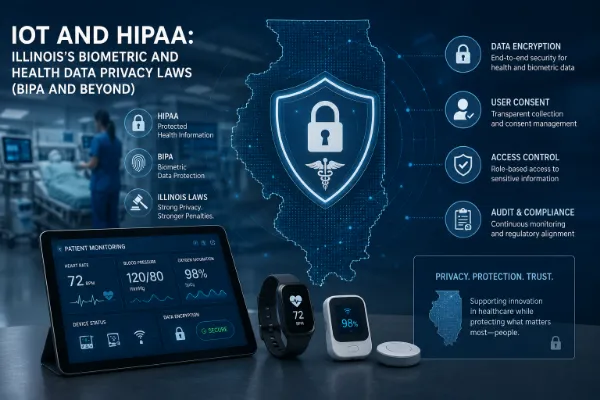
Illinois has, without much competition, the most aggressive biometric privacy law in the country. The Biometric Information Privacy Act, codified at 740 ILCS 14/1 and in effect since October 3, 2008, has generated more than $800 million in settlements from Meta, Google, and TikTok alone, and it carries a private right of action that lets individuals sue directly a genuinely different enforcement model than the Nevada consumer health data law covered elsewhere on this site, where enforcement rests solely with the state attorney general. For any healthcare organization or connected device manufacturer deploying biometric-enabled IoT technology in Illinois fingerprint-based hospital access control, facial recognition patient identification, voiceprint authentication BIPA compliance sits alongside HIPAA as a genuinely separate, and in some ways more consequential, legal framework to navigate.
The Illinois General Assembly passed BIPA in direct response to the 2007 bankruptcy of Pay By Touch, a biometric payment company whose collapse raised urgent questions about what would happen to the millions of fingerprint records the company held, with no legal mechanism forcing their destruction. The law's core logic reflects a genuine, distinctive concern about biometric data specifically: unlike a Social Security number or password, a fingerprint or iris scan cannot be changed if compromised, and BIPA's drafters concluded that permanence demands stronger legal protection than data categories a person can simply reset after a breach. BIPA applies to all private entities operating in Illinois, covering biometric identifiers including retina and iris scans, fingerprints, voiceprints, and hand or facial geometry scans, requiring written notice, written consent, and a published data retention policy before any private entity can collect this category of data at all.
In February 2023, the Illinois Supreme Court ruled 4-3 in Cothron v. White Castle System that a separate BIPA claim accrues every single time a private entity scans or transmits biometric data without consent not just at the point of initial collection. For an employer using a fingerprint-based timeclock system, this ruling meant a single employee clocking in and out daily over years of employment could theoretically generate thousands of separate violations, each carrying statutory damages of $1,000 for negligent violations or $5,000 for intentional or reckless ones, without the individual needing to prove any actual financial or physical harm occurred at all. This per-scan accrual interpretation created the kind of massive, business-threatening damages exposure that drove the wave of BIPA litigation culminating in 427 new class action filings in 2024 alone.
Responding directly to the business community alarm Cothron generated, Illinois Governor Pritzker signed SB 2979 into law on August 2, 2024, amending BIPA specifically to limit damages calculation to a per-person rather than per-violation basis meaning repeated identical collections of the same biometric identifier from the same person using the same collection method now constitute a single violation for damages purposes, regardless of how many individual scans actually occurred. On April 1, 2026, the U.S. Court of Appeals for the Seventh Circuit resolved a genuinely important remaining question in Clay v. Union Pacific Railroad Company, holding that this 2024 damages-limiting amendment applies retroactively to cases that were already pending when the amendment took effect a ruling that provided considerably more certainty to organizations facing existing BIPA litigation, even as BIPA's core collection and consent requirements remained entirely unchanged by the amendment.
A genuinely significant BIPA case for healthcare organizations specifically came from the Illinois Supreme Court's November 2023 ruling in Mosby v. Ingalls Memorial Hospital, which addressed whether BIPA's healthcare exemption which excludes biometric information collected for treatment, payment, or healthcare operations under HIPAA extends to biometric data collected from healthcare employees, rather than patients. The court's ruling clarified that this exemption doesn't automatically extend to employee biometric data collected in the course of providing medical services, meaning a hospital's own biometric access control systems, medication dispensing cabinets requiring fingerprint authentication, and staff time-tracking systems generally remain subject to BIPA's full notice and consent requirements even though the hospital's core patient care activities fall under HIPAA's separate framework. This distinction matters enormously for how hospital facilities teams deploy connected biometric access systems: a fingerprint scanner controlling access to a secure medication room is regulated under BIPA as an employment-related biometric collection, genuinely separate from the HIPAA-governed patient health information the medication room itself might be protecting.
For companies building or selling biometric-enabled IoT devices into Illinois healthcare facilities fingerprint or facial recognition access control, voiceprint-based system authentication, biometric medication dispensing verification BIPA compliance requires genuinely separate documentation and consent workflows from whatever HIPAA compliance program a healthcare customer already maintains. A vendor whose product roadmap assumes HIPAA compliance alone covers a healthcare facility's full legal exposure is missing a substantial and, per Mosby, judicially confirmed separate compliance obligation specifically covering employee-facing biometric collection. Given BIPA's private right of action and the statutory damages structure covered above, healthcare facilities deploying this kind of technology should expect to require documented, written consent processes and published retention policies from any biometric device vendor as a baseline procurement requirement, not an optional add-on.
Even with the 2024 damages amendment reducing potential exposure, BIPA litigation remains genuinely active more than 100 new BIPA class actions were filed in 2025, and recent case trends have specifically examined whether AI systems using facial data for purposes like skincare assessment fall within BIPA's scope, with at least one court holding that AI-generated advice doesn't qualify as medical treatment for purposes of the law's healthcare exemption. This expanding litigation focus on AI-adjacent biometric collection matters directly for healthcare IoT specifically, given how many modern connected medical devices increasingly incorporate AI-driven analysis of biometric or health-adjacent data a genuinely evolving area of BIPA interpretation that healthcare technology vendors should track closely rather than assuming settled case law from earlier, more straightforward fingerprint-timeclock-style cases necessarily extends cleanly to newer AI-integrated biometric technology.
- Determine BIPA applicability separately from HIPAA status, since a device or system fully HIPAA-compliant for patient care purposes may still trigger separate BIPA obligations for employee-facing biometric use, per the Mosby ruling.
- Secure written, documented consent before any biometric collection begins, covering both the initial notice requirement and the specific written release BIPA requires, now including electronic signatures following the 2024 amendment's clarification.
- Publish and maintain a clear biometric data retention and destruction policy, a standing BIPA requirement independent of the 2024 damages amendment.
- Track how AI-driven analysis of biometric or facial data fits into current interpretation trends, given how actively courts have continued examining this specific question through 2025 and 2026.
Frequently asked questions
BIPA, codified at 740 ILCS 14/1 and in effect since 2008, requires private entities to obtain written notice and consent before collecting biometric identifiers like fingerprints, iris scans, or facial geometry, and provides individuals a private right of action to sue for violations.
The Illinois Supreme Court ruled in 2023 that a separate BIPA claim accrues each time biometric data is scanned or transmitted, not just at initial collection, meaning routine repeated use of a system like a fingerprint timeclock could generate massive cumulative statutory damages.
SB 2979, signed August 2, 2024, limits damages to a per-person rather than per-violation basis, meaning repeated identical biometric collections from the same person using the same method now count as a single violation.
Yes. The Seventh Circuit ruled in Clay v. Union Pacific on April 1, 2026 that the amendment applies retroactively to cases pending when it took effect.
Not automatically. The Illinois Supreme Court's 2023 ruling in Mosby v. Ingalls Memorial Hospital clarified that BIPA's HIPAA-related exemption doesn't extend to employee biometric data collected in the course of providing medical services, meaning hospital staff access control systems generally remain subject to BIPA's full requirements.
BIPA provides individuals a private right of action to sue directly, while Nevada's comparable law relies solely on state attorney general enforcement, making Illinois's law considerably more consequential in terms of litigation exposure for covered entities.
Related articles

 Healthcare IoT