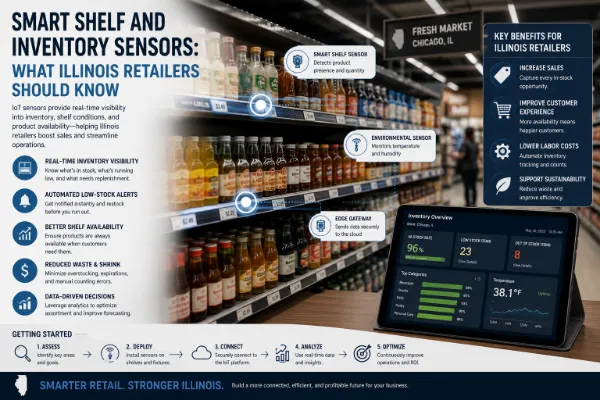
Chicago's Magnificent Mile offers a genuinely useful window into where Illinois retail actually stands in 2026: retail vacancy along North Michigan Avenue has fallen from a 2023 peak of roughly 34% down to around 22%, with real estate analysts projecting it could reach the mid-teens by 2027-2028 and below 10% by 2030. New retailers Uniqlo, Aritzia, the Harry Potter Store, Brooks Brothers are actively filling storefronts that sat empty just a few years ago. This is a genuine recovery, but it's an uneven one, and it's happening alongside a store landscape increasingly built around efficient, technology-enabled operations rather than the pre-pandemic retail model. Smart shelf and inventory sensor technology fits directly into how Illinois retailers are approaching this rebuilding phase.
The category spans several genuinely distinct technologies retailers are deploying, often in combination:
- Electronic shelf labels (ESLs): E-ink or LCD price tags updating remotely and instantly, eliminating manual paper tag changes across a store.
- Weight sensors: Shelf-integrated scales detecting product removal or restocking, converting weight changes into real-time inventory counts.
- RFID tagging: Tags read by shelf or gateway antennas without requiring line of sight, supporting both inventory accuracy and shrinkage detection simultaneously.
- Computer vision cameras: AI-paired cameras detecting empty shelf space or misplaced items visually, without requiring individual item-level tagging.
A genuinely important dynamic shaping Illinois retail right now, and Chicago's Mag Mile specifically, is landlords and tenants adapting to new market demands by adopting smaller, more efficient store layouts rather than the larger-format flagship stores that once defined premium Illinois retail corridors. This shift toward smaller footprints changes the smart shelf investment calculation directly: a smaller store has proportionally less floor space to instrument, meaning the same technology investment can achieve more comprehensive coverage relative to total selling space than it could in a larger, pre-pandemic-era flagship format. For a retailer opening a new, deliberately compact location along a recovering corridor like the Mag Mile, comprehensive smart shelf coverage from day one is a more realistic goal than it would have been for a comparable large-format store a decade ago.
Retailers opening or expanding into Illinois's recovering downtown corridors are making real capital commitments into a market that, while improving, still carries genuine uncertainty about how quickly weekday foot traffic specifically will recover to pre-pandemic levels, covered in more detail in this site's coverage of Illinois foot traffic analytics. In this environment, minimizing the operational cost of inventory management errors stockouts during a weekend traffic surge, or overstocking ahead of a weekday period that historically underperforms carries outsized value for retailers still working to establish sustainable unit economics in a market that hasn't fully normalized. Real-time inventory visibility through smart shelf sensors lets a store respond to Illinois retail's genuinely uneven weekday-versus-weekend demand pattern considerably faster than a periodic manual count cycle would allow.
Given Illinois's genuine, well-documented organized retail crime environment, covered in more depth in this site's coverage of loss prevention for Illinois retailers, RFID-based smart shelf technology increasingly serves a dual purpose beyond pure inventory management the same tagging infrastructure that enables real-time stock visibility also supports faster shrinkage detection, since a tagged item crossing an exit sensor without a corresponding transaction triggers an immediate alert. For Illinois retailers specifically, particularly those in categories frequently targeted by organized retail theft rings electronics, tools, premium apparel this dual-purpose value proposition strengthens the overall business case for RFID investment beyond what a pure inventory accuracy argument alone would justify.
The specific retailers actively opening new Illinois locations in 2026 offer a useful signal about the technology sophistication increasingly expected in this market brands like Teso Life, described locally as the "Asian Target" and recently opening a second Illinois location in Naperville, and digital-native brand concepts like Live Launch in the West Loop, represent retail models built from the ground up around efficient, technology-integrated operations rather than legacy store formats retrofitted with new sensors after the fact. New entrants to the Illinois market building smart shelf and inventory technology into their initial store design, rather than treating it as a later retrofit, are increasingly setting the operational efficiency bar that longer-established Illinois retailers need to match to remain competitive on cost structure alone.
- Start with electronic shelf labels in categories with frequent price changes, delivering the fastest measurable labor savings without requiring a broader inventory system overhaul.
- Add RFID to high-shrinkage categories first, informed by what Illinois's documented organized retail crime patterns reveal about locally targeted merchandise types.
- Layer in weight sensors for high-velocity categories most exposed to the kind of demand volatility a recovering downtown corridor's uneven weekday-weekend traffic pattern creates.
- Evaluate computer vision once baseline inventory data is trusted, since it delivers the most value layered on top of an already-functioning data foundation rather than as a first deployment.
Electronic shelf labels typically run from a few dollars to around ten dollars per label depending on size and display type, a modest incremental cost relative to the real estate investment already required to lease space along a recovering corridor like the Mag Mile or Fulton Market. Weight sensor and RFID infrastructure costs vary more by scale, but modular, retailer-scale systems have become considerably more accessible than the enterprise platforms originally built for national big-box chains a genuine advantage for the smaller, independent boutique retailers, like Raw Edge at The Shops at North Bridge, covered in more detail in this site's coverage of Illinois foot traffic recovery, that make up a meaningful share of the retailers actively reopening along Illinois's recovering downtown corridors.
Illinois retailers evaluating smart shelf vendors should specifically ask about experience with compact, efficient store formats given the market's current leasing trend toward smaller footprints, rather than assuming a vendor's large-format retail case studies translate directly to a genuinely different store size and layout. It's also worth asking whether a prospective vendor's platform integrates with the loss prevention and organized retail crime documentation infrastructure covered in more detail elsewhere on this site, given how directly Illinois's specific prosecution framework depends on exactly the kind of timestamped, cross-location evidence a well-integrated RFID and inventory system can help generate.
Frequently asked questions
Vacancy has fallen from a 2023 peak of roughly 34% to around 22% as of 2026, with projections suggesting mid-teens vacancy by 2027-2028 and below 10% by 2030.
Smaller stores have proportionally less floor space to instrument, making comprehensive smart shelf coverage a more achievable goal relative to total selling space than it would be in a larger, pre-pandemic-era flagship format.
RFID tagging that enables real-time inventory visibility also supports faster shrinkage detection, triggering alerts when tagged items cross exit sensors without a corresponding transaction, adding value given Illinois's documented organized retail crime environment.
New entrants like Teso Life and digital-native concepts like Live Launch are building technology-integrated operations into their initial store design, setting an efficiency bar longer-established retailers increasingly need to match.
No. A phased approach starting with electronic shelf labels in frequently-repriced categories, then RFID in high-shrinkage categories, tends to deliver faster measurable returns than broad, undifferentiated coverage from day one.
With weekday foot traffic still recovering unevenly compared to weekends, minimizing stockouts and overstocking errors carries outsized value for retailers still establishing sustainable unit economics in a market that hasn't fully normalized.
Related articles

 Retail IoT