Illinois built a genuinely coordinated statewide response to organized retail crime, and it gives retailers a distinctive set of resources most states don't offer. Since 2023, organized retail theft has been a specific felony offense under Illinois law, codified at 720 ILCS 5/16-25.1 retail theft committed with one or more other people, where the value of merchandise stolen over a 90-day period exceeds $300, escalating from a Class 3 felony above that threshold up through a Class 1 felony for thefts exceeding $100,000. For Illinois retailers, IoT-based loss prevention technology increasingly plugs directly into this state-level enforcement infrastructure, not just into a store's own internal security operations.
Illinois Attorney General Kwame Raoul established a dedicated Organized Retail Crime Task Force in 2021, working alongside the U.S. Secret Service, the Department of Homeland Security, the Illinois State Police, the Cook County Sheriff's Office, and both the Illinois Association of Chiefs of Police and the Illinois Association of State's Attorneys. The task force maintains direct consultation relationships with the Illinois Retail Merchants Association, the Magnificent Mile Association, and national retailers including CVS, Home Depot, Lowe's, Target, Walgreens, and Walmart meaning Illinois retailers of meaningful scale already have an established channel for reporting organized theft patterns directly into a coordinated statewide investigation infrastructure, rather than relying solely on individual local police department relationships.
The Illinois Organized Retail Crime Association maintains and promotes Auror, a crime intelligence platform functioning as a real-time repository letting retailers, law enforcement, and loss prevention specialists share intelligence about organized theft networks. The platform converts individually reported incidents into detailed timelines, linking crimes through maps, video, and other shared evidence, making it considerably easier to spot patterns and share data across jurisdictional lines. As one law enforcement official involved with the platform explained, retail thieves typically move along a specific route, meaning tracked incident data can reveal where a theft ring has already struck and help predict where they might target next allowing, for example, a liquor store that learns a couple of nearby high-end locations were recently hit to take proactive precautions before becoming the next target itself. Membership in ILORCA, and access to Auror, is free a genuinely low-barrier entry point for Illinois retailers of any size to participate in this shared intelligence infrastructure, not just the large national chains with dedicated loss prevention departments.
Given how Illinois's organized retail crime statute specifically allows prosecutors to aggregate stolen merchandise value across multiple incidents at different store locations within the same 90-day window as long as the incidents represent a continuing course of conduct from the same retail chain documented, timestamped evidence from IoT security systems has become directly relevant to how these cases actually get charged and prosecuted, not just to internal loss prevention response. A real Will County example illustrates the mechanism directly: what might look like a single, minor shoplifting incident at one store location can trigger felony charges once prosecutors aggregate the value of merchandise stolen from the same retail chain across multiple locations over the relevant time window, provided law enforcement has the documented evidence connecting these incidents to the same individuals or organized network.
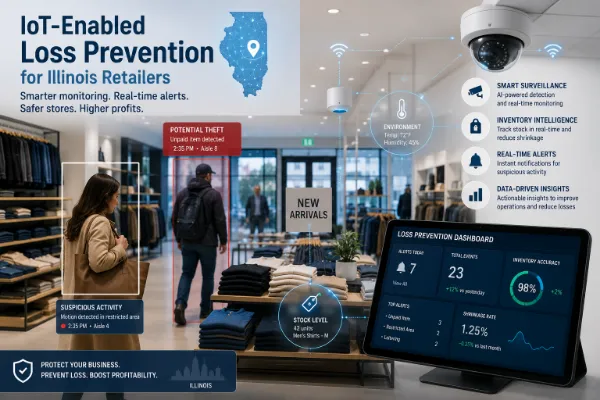
Major chains operating in Illinois markets like Joliet Target, Walmart, Kohl's, and stores within Louis Joliet Mall have adopted sophisticated surveillance systems including facial recognition technology and coordinated tracking of suspected shoplifters across multiple store locations, directly supporting the kind of cross-location evidence aggregation Illinois's organized retail crime statute is specifically built to prosecute. This connects directly to the broader AI-driven video intelligence category covered in more detail in this site's coverage of loss prevention technology generally platforms that flag coordinated group activity, systematic concealment behavior, and repeated visits consistent with a theft ring casing a location, now carrying genuine additional value in Illinois specifically because the resulting documentation feeds directly into a prosecution framework built around exactly this kind of cross-incident, cross-location pattern evidence.
Illinois Attorney General enforcement actions illustrate what this coordinated infrastructure actually looks like in practice one case resulted in felony charges against a St. Clair County man for allegedly purchasing and reselling approximately $243,000 in stolen tools and electronics, with the Illinois State Police and Illinois Department of Revenue both assisting the multi-jurisdictional investigation facilitated through Raoul's task force. As the Attorney General's office has noted publicly, the effects of organized retail crime aren't limited to any single region of Illinois, and proceeds from stolen merchandise resale often fund additional criminal activity a framing that positions IoT-driven loss prevention and documentation not merely as a store-level cost-reduction measure, but as a genuine contribution to the broader state investigation and prosecution effort targeting these networks specifically.
Given how directly Illinois's prosecution framework depends on documented, evidence-backed connections between individual theft incidents, RFID tagging on high-value categories electronics, tools, premium apparel, the same categories the St. Clair County case and Joliet-area enforcement examples above both illustrate as frequent targets offers Illinois retailers a documentation benefit beyond the immediate loss prevention value covered elsewhere on this site. A tagged item crossing an exit sensor without a corresponding transaction generates a timestamped record that, combined with video evidence and shared intelligence through platforms like Auror, strengthens exactly the kind of cross-incident evidentiary chain Illinois prosecutors need to pursue organized retail crime charges rather than treating each incident as an isolated, low-level shoplifting case.
Illinois's organized retail theft framework also addresses the resale side of the problem directly web-based marketplaces are required by law to verify the identity of high-volume sellers, specifically to cut down on stolen merchandise being resold online with limited traceability back to the original theft. This matters for how Illinois retailers should think about the full loss prevention picture: IoT-driven in-store detection and documentation covered throughout this article addresses the theft itself, while the marketplace verification requirement addresses the resale channel that gives organized theft rings their financial incentive in the first place, and retailers benefit from understanding both halves of this enforcement framework rather than focusing purely on in-store prevention technology in isolation.
For an Illinois retailer evaluating loss prevention investment, the practical sequencing should account for this state's genuinely unusual, coordinated enforcement infrastructure directly: joining ILORCA and adopting Auror costs nothing and immediately connects a store to shared intelligence about active theft patterns in its specific area, AI-driven video analytics and RFID tagging on high-risk categories generate the kind of documented, timestamped evidence Illinois's cross-location prosecution framework actually depends on, and consistent incident reporting even for what feels like a minor individual theft feeds directly into the aggregate evidence base that turns isolated incidents into prosecutable organized retail crime cases under Illinois's specific statutory framework.
Frequently asked questions
Since 2023, codified at 720 ILCS 5/16-25.1, covering retail theft committed with others where the merchandise value stolen over a 90-day period exceeds $300, with felony classification escalating based on total value.
A collaboration established by Attorney General Kwame Raoul in 2021, bringing together the Secret Service, Department of Homeland Security, Illinois State Police, and major national and Illinois retailers to investigate and prosecute organized theft networks.
Auror is a real-time crime intelligence platform letting retailers and law enforcement share timeline, map, and video evidence about organized theft patterns, with free access through membership in the Illinois Organized Retail Crime Association.
Under 720 ILCS 5/16-25.1, merchandise value stolen from the same retail chain across multiple locations within a 90-day window can be aggregated for felony charging purposes, provided incidents represent a continuing course of conduct.
Given Illinois's cross-location, cross-incident prosecution framework, timestamped video and RFID exit sensor data help build the kind of evidentiary chain connecting individual incidents into prosecutable organized retail crime cases.
A St. Clair County case resulted in felony charges against a man allegedly purchasing and reselling approximately $243,000 in stolen tools and electronics, investigated through a multi-jurisdictional effort involving the Illinois State Police and Department of Revenue.
Related articles

 Retail IoT