
Sometimes it takes a fish to do a man’s job.
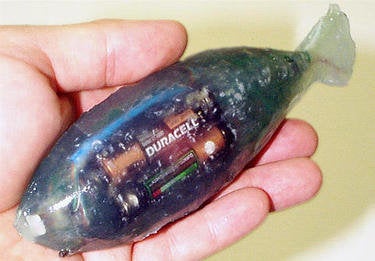
Scientists at the Pacific Northwest National Laboratory have developed a sensor-laden, synthetic Sensor Fish that can be used to swim into hydropower facilities like dams to evaluate structures and other environmental systems.
+More on Network World: The weirdest, wackiest and coolest sci/tech stories of 2014 (so far!)+
Using Sensor Fish, PNNL researchers say they can measure the various forces juvenile salmon experience as they pass through dams. The Sensor Fish initially was designed to evaluate dams equipped with a common type of turbine along the Columbia River, the Kaplan turbine. The pressure change, they found, is akin to traveling from sea level to the top of Mount Everest in blink of an eye, the PNNL researchers said in a release.
A second generation of Sensor Fish slated for use next year is more flexible and can check out more facilities.
According to PNNL, most large dams in the U.S. were built in the 1970s or earlier and will soon need to be relicensed — a process that includes evaluating and often reducing a dam’s environmental impact. Key to that evaluation is examining how fish fare when swimming through dams. “Many people assume fish swimming through dams are only injured when turbine blades hit them, but PNNL’s research has shown there are many different forces that can harm fish, including abrupt pressure changes in dam turbine chambers. That knowledge is helping redesign dam turbines so they create less severe pressure changes while maintaining or even improving power productions,” PNNL said.
 PNNL
PNNLPacific Northwest National Laboratory scientists have developed an electronic sensor fish that is designed to record some of the environmental conditions fish may encounter while passing through hydropower turbines. The original six-inch rubbery fish (pictured) has since been revised into the form of a 3.6-inch plastic tube. Courtesy of Pacific Northwest National Laboratory.
The fish swims through the system being tested and collects sensor data and saves it to flash memory. Once the fish is recovered it is placed in a docking station for downloading.
Some quick facts about the sensor fish:
- It measures physical stresses juvenile fish experience such as pressure, acceleration, strain and turbulence
- Same size as juvenile salmon; other models being developed to mimic other fish species.
- Length: ~3.5 inches
- Diameter: ~1 inch
- Weight: ~1.5 ounces
- Cost: $1,200 each
- ~5 minutes of data with flash memory
- 2,048 measurements per second
- Can handle 174 pounds per square inch of pressure
- Neutrally buoyant — allows device to float below surface like a real fish
- Automatically floats to surface at end of test by dropping a pair of small weights
- Features four LED lights that flash green, orange & yellow for retrieval and diagnostics
- Powered by a rechargeable 3.7-volt lithium-ion battery
- Users interact with the Sensor Fish via communication software developed at Pacific Northwest National Laboratory, with the serial port configured to 921.6 kbps, 8 data bits, 1 start bit, 1 stop bit, and no parity.
- Contains built-in radio-frequency transmitter for recovery
Check out these other hot stories:
Have E-ZPass? Watch out for slimy ASProx-based malware ploy
Follow-up: Virgin Galactic spacecraft crash
Air Force envisioning swarms of tiny, inexpensive, almost disposable drones
Guinness World Record: Amplifier operates at a speed of one trillion cycles per second