Hammond-Henry Hospital in Geneseo met with Illinois state lawmakers in January 2026 to deliver a direct warning: changing federal Medicaid policy could force the rural hospital to cut non-revenue services entirely unless state lawmakers stepped in. "Net operating revenues and margins they start to close in," the hospital's CEO explained. This isn't an isolated concern a Chartis report on rural hospital finances found that Illinois rural hospitals stand to lose $10.6 million in 2025 alone from a specific reimbursement change tied to charity care, one of the states hit hardest nationally by this particular federal policy shift. Illinois's health system genuinely spans two very different worlds dense, resource-rich urban and suburban Chicago-area care alongside a rural downstate safety net facing real financial strain and remote patient monitoring has become one of the more practical tools connecting these two systems.
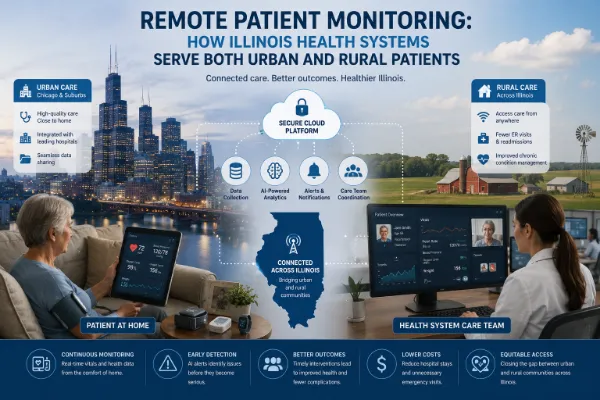
Illinois's Telehealth Act, codified at 225 ILCS 150, requires providers to deliver virtual care under the same standard of care as in-person visits and mandates that most private insurers cover telehealth on par with traditional office visits a legal framework that treats remote monitoring and virtual care as genuinely equivalent to in-person medicine rather than a lesser substitute. The state's remote monitoring infrastructure has historically been organized around a regional division of coverage among major health systems: OSF HealthCare providing telehealth services across Central Illinois, the Metro East region, and Rockford; SIU Medicine covering Southern and West Central Illinois; and Advocate Health serving most of Northern Illinois. This regional structure matters directly for how remote patient monitoring programs actually get deployed a patient's specific health system relationship, shaped heavily by which region of the state they live in, determines which monitoring infrastructure and clinical support network they're actually connected to.
Illinois has built direct state funding into its Medicaid program specifically to support rural telehealth infrastructure since dates of service beginning January 1, 2024, the state has provided at least $3.5 million in annual financial support to public, critical access hospitals for delivering perinatal, obstetrical and gynecological services, behavioral healthcare including substance use disorder treatment, telehealth services, and other specialty care. This targeted funding stream reflects genuine legislative recognition that rural Illinois hospitals face structurally different financial pressures than their urban and suburban counterparts, and that telehealth and remote monitoring infrastructure specifically needs dedicated support to remain viable in these lower-volume, more financially constrained rural settings rather than assuming the same market dynamics supporting urban telehealth adoption apply uniformly statewide.
CMS permanently removed frequency limits on subsequent inpatient and nursing facility visits and critical care consultations delivered via telehealth for 2026, alongside the earlier, now-permanent elimination of geographic restrictions on behavioral health telehealth services meaning Medicare patients no longer need to be located in a designated rural area to access behavioral telehealth specifically. For Illinois's rural hospital network, already navigating the kind of Medicaid reimbursement pressure covered above, this expanded federal telehealth flexibility offers a genuine, if partial, offset a rural facility unable to justify maintaining certain specialty services in person can lean more heavily on expanded telehealth coverage to maintain patient access to those services remotely, provided the underlying remote monitoring and virtual care infrastructure is actually in place to support it.
A specific, often overlooked piece of Medicare's telehealth reimbursement structure carries genuine relevance for rural Illinois facilities: Medicare pays an originating site facility fee to the location where a patient is physically present during a telehealth visit, set for 2026 at 80% of the lesser of the actual charge or $31.85. For a rural critical access hospital serving as the originating site for a patient's telehealth visit with a specialist based in Chicago or another regional hub, this fee while modest on a per-visit basis represents a genuine, if small, revenue stream that helps offset some of the facility cost of maintaining the physical space, connectivity infrastructure, and staff support needed to host telehealth visits locally, rather than requiring rural patients to travel to a distant specialist's physical location entirely.
In practice, the device categories doing the work of Illinois remote patient monitoring cellular-connected blood pressure cuffs, glucose monitors, weight scales, and pulse oximeters supporting chronic disease management don't differ dramatically between urban and rural deployment. What differs is the clinical support infrastructure surrounding those devices: an urban Chicago-area health system like Advocate Health or Northwestern Medicine can typically support a dedicated remote monitoring clinical team reviewing device data continuously, while a smaller rural critical access hospital, operating under the kind of financial pressure covered throughout this article, may need to rely more heavily on regional partnerships connecting a local patient's monitoring data back to a specialist team based at OSF HealthCare's broader network hub, rather than maintaining an equivalent dedicated monitoring team locally.
For an Illinois family evaluating remote monitoring options for an aging parent or chronically ill relative, the practical starting point is understanding which of the state's major regional telehealth networks actually serves their specific area a Rockford-area family working with OSF HealthCare has a genuinely different support infrastructure available than a Southern Illinois family within SIU Medicine's coverage area, even though both fall under Illinois's same statewide Telehealth Act framework. Given the genuine financial pressure facing rural facilities specifically, families in these areas should ask directly what happens if a specific monitoring program's funding or staffing changes a reasonable question given how directly hospital leadership has warned lawmakers about potential future service cuts.
Given the genuine financial strain covered throughout this article Medicaid reimbursement pressure, charity care cut impacts specifically concentrated in Illinois relative to other states, and hospital leadership directly warning lawmakers about potential service cuts remote patient monitoring is likely to become an increasingly central tool for Illinois's rural health systems specifically because it offers a way to maintain patient access to specialty care without requiring the same fixed local staffing and infrastructure costs that in-person specialty service delivery demands. The genuine risk worth watching is whether the state's targeted funding mechanisms, like the $3.5 million annual rural telehealth support program, scale adequately to match the pace of rural hospital financial pressure, or whether remote monitoring infrastructure investment itself becomes one of the "non-revenue services" rural hospital leaders have warned could face cuts if broader funding pressure continues.
Frequently asked questions
A Chartis report found Illinois rural hospitals stand to lose $10.6 million in 2025 from a specific charity care reimbursement cut, among the hardest-hit states nationally, and hospital leaders like Hammond-Henry Hospital's CEO have directly warned state lawmakers about potential service cuts.
OSF HealthCare has historically covered Central Illinois, the Metro East region, and Rockford; SIU Medicine covers Southern and West Central Illinois; and Advocate Health serves most of Northern Illinois.
Yes. Since January 2024, the state has provided at least $3.5 million annually to public, critical access hospitals supporting perinatal, behavioral health, telehealth, and other specialty service delivery.
CMS permanently removed frequency limits on subsequent inpatient and nursing facility telehealth visits and critical care consultations, building on the earlier permanent elimination of geographic restrictions for behavioral health telehealth.
It's a payment to the location where a patient is physically present during a telehealth visit, set for 2026 at 80% of the lesser of the actual charge or $31.85, providing rural facilities hosting local telehealth visits a modest revenue stream.
Larger urban systems can typically support dedicated remote monitoring clinical teams, while smaller rural facilities often rely on regional partnerships connecting local patient data back to specialist teams at larger network hubs.
Related articles

 Healthcare IoT