Illinois's manufacturing employment doesn't concentrate in a single city the way some states' industrial bases do. Chicago leads with roughly 94,574 manufacturing jobs, but Rockford follows with 16,380, and Elk Grove Village rounds out the top three with 15,772 a genuinely dispersed geography spanning dense urban manufacturing, mid-size regional industrial cities, and suburban industrial parks simultaneously. For manufacturers operating anywhere in this landscape, unplanned downtime carries real, direct cost regardless of location, but the practical sensor strategy for actually reducing it needs to account for how genuinely varied Illinois's manufacturing facility types and ages actually are across this dispersed geography.
The most consistent mistake in downtime-reduction projects, regardless of location, is attempting to instrument an entire facility simultaneously rather than ranking equipment by a combination of failure probability and the actual cost of a stoppage. For an Illinois manufacturer specifically, that cost calculation should account for the state's genuinely tight labor market pressures covered in more depth in this site's broader coverage of Illinois's aging industrial base a production line down for lack of a specialized technician carries real opportunity cost given how competitive skilled manufacturing labor recruitment has become across the state's dispersed industrial centers.
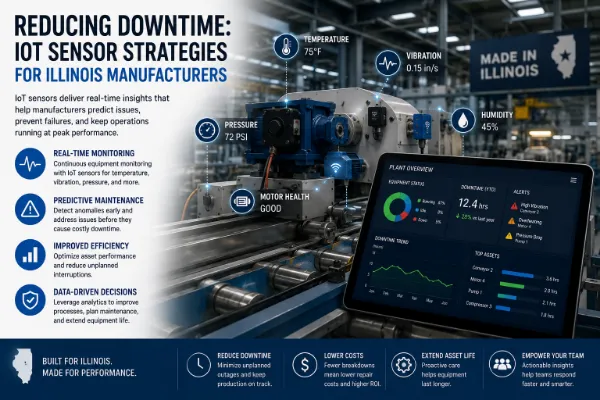
Given how diversified Illinois's manufacturing base has become, covered in more depth in this site's coverage of the state's quality control landscape, an effective downtime-reduction sensor strategy needs to span genuinely different equipment categories depending on which segment a given facility operates in:
- Vibration and thermal monitoring on precision manufacturing and assembly equipment, catching bearing wear and mechanical degradation before it produces a full equipment failure or out-of-tolerance output.
- Environmental control monitoring for pharmaceutical and food processing facilities, where an environmental control failure represents both a downtime risk and a potential product safety or regulatory compliance issue simultaneously.
- Power quality and electrical load monitoring, broadly applicable across every manufacturing category and particularly relevant given Illinois's evolving utility rate structure covered in more detail in this site's coverage of the state's energy landscape.
- Overall Equipment Effectiveness (OEE) tracking, pulling data from equipment controllers already present on most modern manufacturing equipment, tying the above signals into a single, comparable performance metric across genuinely different equipment types.
Illinois's demanding dual-season climate, covered in more detail in this site's broader coverage of surviving extreme cold, creates a genuinely seasonal dimension to manufacturing downtime risk that facilities in milder climates don't need to plan around as carefully. Facility HVAC and building envelope failures during extreme cold events can indirectly affect manufacturing equipment reliability a mechanical room losing heat during a subzero cold snap risks freezing water-cooled equipment or pneumatic control lines, a genuinely different failure mode than the equipment's own internal wear patterns would produce on their own. Illinois manufacturers should factor winter-specific building envelope and mechanical room monitoring into their broader downtime-reduction sensor strategy, not just equipment-level sensors focused purely on the production machinery itself.
Illinois manufacturers operating across this dispersed geography from dense Chicago facilities to Rockford's and Elk Grove Village's own distinct industrial histories often carry a genuine mix of legacy equipment predating modern IoT connectivity alongside newer machinery, covered in more depth in this site's broader retrofit guide for Illinois's legacy factory floors. The practical retrofit path for this older equipment mirrors that broader guidance: wireless vibration and current sensors mounted externally without disturbing existing control logic, avoiding the extensive rewiring that would otherwise require costly production downtime specifically to install the monitoring equipment meant to reduce downtime in the first place.
| Metric | Typical Improvement With a Layered Sensor Strategy |
|---|
| Unplanned downtime | 30% – 50% reduction |
| Overall maintenance costs | ~25% reduction |
| Equipment uptime | 10% – 20% improvement |
| Asset useful life | 20% – 30% extension |
These figures describe mature, well-instrumented programs following a disciplined, phased rollout. Most manufacturers following this kind of phased approach report reaching breakeven on the initial investment somewhere between six and fourteen months.
A practical architectural decision every Illinois manufacturer runs into is where sensor data actually gets processed. Sending every vibration or thermal reading to the cloud for analysis is increasingly viewed as unnecessary and costly for time-sensitive anomaly detection edge processing, where a local gateway handles initial analysis and only forwards meaningful events or summarized data upstream, delivers faster response times and lower ongoing data transmission costs. This matters particularly for manufacturers weighing Illinois's evolving utility rate structure, covered in more detail in this site's coverage of the state's Performance-Based Rate-Making system, since a monitoring architecture that itself adds meaningful electrical load through constant high-bandwidth data transmission works against the same cost-efficiency goals the sensor deployment is often partly justified by.
For manufacturers operating multiple facilities across Illinois's dispersed industrial geography a company with operations in both Chicago and a smaller downstate or suburban facility, for example a shared, cloud-based monitoring dashboard aggregating data across every location delivers considerably more strategic value than facility-by-facility, siloed monitoring implementations. This kind of unified visibility lets operations leadership compare downtime patterns and equipment performance across genuinely different facility types and ages within the same company, identifying whether a specific equipment failure pattern reflects a facility-specific issue or a broader equipment category problem worth addressing across the entire multi-site operation simultaneously.
For an Illinois manufacturer building an internal case for downtime-reduction sensor investment, the most persuasive framing typically connects directly to costs the facility is already absorbing rather than a general efficiency argument: pulling a year of unplanned downtime incidents and calculating how many could plausibly have been caught days or weeks in advance by continuous monitoring turns an abstract technology pitch into a concrete number tied to the facility's own operating history. Given the tight skilled labor market covered throughout this article, quantifying how much of that downtime specifically resulted from delayed access to a specialized technician, rather than the underlying mechanical failure itself, provides a second, independent line of justification that speaks directly to Illinois's genuine current workforce constraints.
Frequently asked questions
Chicago leads with roughly 94,574 manufacturing jobs, followed by Rockford with 16,380 and Elk Grove Village with 15,772, reflecting a genuinely dispersed geography rather than concentration in a single industrial center.
Extreme cold events can cause facility HVAC and building envelope failures that indirectly affect manufacturing equipment, such as freezing water-cooled systems or pneumatic control lines, requiring winter-specific monitoring beyond equipment-level sensors alone.
Vibration and thermal monitoring for precision equipment, environmental control monitoring for pharmaceutical and food facilities, and power quality monitoring apply across the state's varied manufacturing sectors.
No. Wireless retrofit sensors can extract useful data from most legacy equipment without replacing it, avoiding the costly downtime that installing wired monitoring equipment would otherwise require.
Well-scoped programs commonly reach breakeven between six and fourteen months, following a phased rollout prioritizing the highest-consequence equipment first.
It lets operations leadership compare downtime patterns across genuinely different facility types and ages within the same company, identifying whether an issue is facility-specific or reflects a broader equipment category problem.
Related articles

 Manufacturing IoT