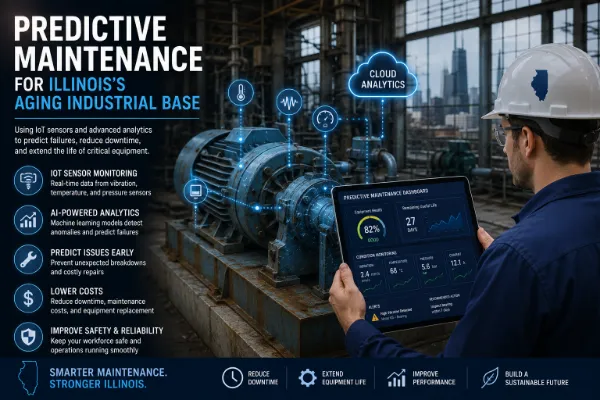
Illinois sits squarely within the Rust Belt the historic manufacturing, steelmaking, and industrial region spanning Illinois, Indiana, Michigan, Ohio, Pennsylvania, and neighboring states that experienced sustained industrial decline beginning as early as the 1950s and accelerating through the 1970s. Decatur, Illinois specifically appears among the cities that saw significant population loss during this deindustrialization period, a pattern shared with cities like Flint, Michigan and Dayton, Ohio. But the Rust Belt story in 2026 is genuinely more nuanced than simple decline Illinois remains a top-five U.S. manufacturing state, and the equipment still running in its older industrial facilities represents both a genuine maintenance liability and a genuine opportunity for predictive maintenance technology to extend the working life of capital equipment that would be enormously expensive to replace wholesale.
Industry-wide analysis heading into 2026 has been direct about a demographic reality reshaping manufacturing workforce planning nationally: an aging workforce combined with declining interest in traditional manufacturing careers among younger workers is intensifying talent shortages precisely as reshoring initiatives and regionalized supply chains create renewed demand for localized manufacturing skills. This compounds the aging equipment challenge in a genuinely direct way a facility running decades-old machinery increasingly can't rely on the kind of institutional, tribal knowledge that veteran maintenance staff historically carried about a specific aging machine's quirks and failure patterns, since that generation of technicians is retiring faster than replacement talent is entering the field. Predictive maintenance sensors and documented, data-driven failure analysis become considerably more valuable in this environment specifically because they capture and formalize knowledge that used to live primarily in an experienced technician's head, making that knowledge accessible to a newer, less experienced maintenance workforce.
A notable and fairly recent development affecting Rust Belt manufacturing broadly, including Illinois specifically, is the growing strain that nearby data center development is placing on regional electricity costs industry coverage from mid-2026 has specifically documented Big Tech data centers driving up power bills at Rust Belt factories, as massive, continuous data center electricity demand competes for the same regional grid capacity that manufacturing facilities depend on. This dynamic adds real urgency to the energy efficiency case for predictive maintenance in Illinois specifically: equipment operating inefficiently a bearing wearing down, a motor drawing more current than its rated specification doesn't just risk a costly failure, it also compounds an already-rising electricity cost burden a facility can't easily control on the demand side of the equation. Continuous IoT monitoring that catches inefficient equipment operation before it becomes an outright failure delivers value on both fronts simultaneously in this specific cost environment.
The Illinois Manufacturers' Association's 2026 legislative agenda specifically calls for modernizing and investing in infrastructure that moves people and products, alongside reducing regulatory burden and healthcare costs affecting employer flexibility priorities that reflect genuine, ongoing advocacy for the kind of capital investment predictive maintenance and broader IIoT modernization requires. Governor Pritzker's administration has separately signaled a more cautious, infrastructure-aware approach to new industrial development specifically, proposing in early 2026 a temporary pause on new data center tax incentives pending evaluation of grid capacity and energy impacts a decision that, combined with the rising power cost pressure covered above, suggests Illinois's policy environment is increasingly attentive to how new large-scale electricity demand affects the state's existing manufacturing base rather than treating data center growth and traditional manufacturing as entirely separate policy questions.
For manufacturing equipment that's genuinely aged well past its original design life common across Illinois's older industrial facilities, many built decades before modern sensor technology existed predictive maintenance delivers value through a somewhat different mechanism than it does for newer equipment. Rather than optimizing an already well-documented, manufacturer-supported maintenance schedule, IoT sensors on genuinely old equipment often need to establish an entirely new performance baseline from scratch, since original manufacturer documentation may be incomplete, outdated, or simply unavailable for equipment this old. This makes the initial baseline-establishment period of a predictive maintenance deployment considerably more important for aging equipment than it would be for newer machinery arriving with comprehensive manufacturer specifications already in hand a facility manager should expect a longer initial calibration period before the system's failure predictions become genuinely reliable, and should plan the deployment timeline accordingly rather than expecting immediate, fully accurate predictive alerts from day one.
Beyond simply extending equipment life, continuous IoT monitoring data on aging Illinois manufacturing equipment provides genuinely valuable input into a decision facility managers face regularly but often without great data: whether a specific piece of aging equipment is a good candidate for continued predictive-maintenance-supported operation, or whether it's reached the point where capital replacement makes more financial sense than continued repair investment. Documented failure patterns, rising maintenance cost trends, and declining energy efficiency data all generated through the same sensor infrastructure covered throughout this article give facility managers a considerably more defensible, data-backed case for capital replacement requests than the more subjective "this machine feels like it's getting less reliable" argument that often accompanies aging equipment replacement decisions made without this kind of continuous monitoring history.
The broader national reshoring trend, driven by rising overseas labor costs and ongoing supply chain disruption concerns, creates a genuinely interesting tension for Illinois manufacturers operating older facilities specifically: renewed domestic manufacturing demand increases the pressure to keep aging equipment running productively rather than accepting extended downtime for a full replacement, even as that same aging equipment becomes harder to staff and maintain given the workforce transition covered above. Predictive maintenance technology sits precisely at the intersection of these two pressures, offering a way to extend productive equipment life during a period of genuinely increased manufacturing demand, without requiring the kind of extended capital replacement timeline that reshoring-driven urgency often can't accommodate.
For an Illinois manufacturer operating genuinely aging equipment, the practical case for predictive maintenance investment in 2026 rests on a combination of factors specific to this moment: a workforce transition already underway that makes formalized, sensor-captured equipment knowledge more valuable than it would have been a decade ago, a rising regional electricity cost environment that rewards catching inefficient equipment operation early, and a state policy environment showing genuine attention to industrial infrastructure investment even as it grows more cautious about new large-scale electricity demand from other sectors. Taken together, these factors argue for treating predictive maintenance less as a discretionary efficiency upgrade and more as infrastructure that helps an aging facility navigate a genuinely challenging combination of workforce and energy cost pressures simultaneously.
Frequently asked questions
Yes. Illinois is included among the traditional Rust Belt states, and Decatur specifically is cited among cities that experienced significant population decline during the broader deindustrialization period beginning in the 1950s and 1970s.
As experienced technicians with deep institutional knowledge about specific aging equipment retire faster than replacement talent enters the field, sensor-captured, documented failure data helps formalize knowledge that used to depend on individual veteran staff.
Industry reporting from mid-2026 has documented data center electricity demand driving up power bills at Rust Belt factories, adding real urgency to catching inefficient equipment operation before it compounds an already-rising cost burden.
The administration proposed a temporary pause in early 2026 specifically to evaluate grid capacity and energy impacts, reflecting growing state attention to how large new electricity demand affects existing industrial and manufacturing users.
Original manufacturer documentation for decades-old equipment may be incomplete or unavailable, requiring sensors to establish an entirely new performance baseline from scratch rather than optimizing an already well-documented maintenance schedule.
Documented failure patterns, rising maintenance costs, and declining efficiency trends give facility managers a data-backed case for capital replacement requests, rather than relying on subjective assessments of declining equipment reliability.
Related articles

 Industrial IoT (IIoT)