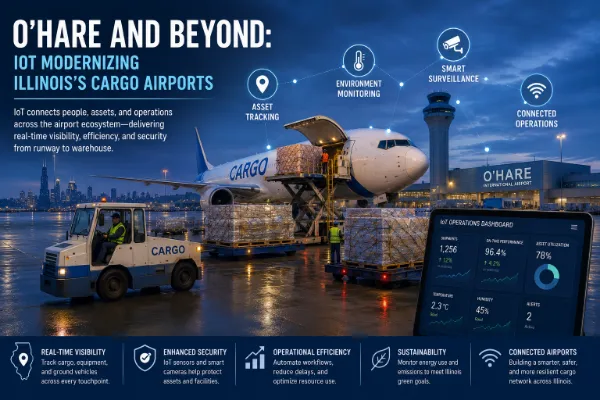
O'Hare International Airport processes more than two million metric tons of air cargo annually, worth over $200 billion ranking it #1 by freight value among all airports in the Americas and placing it in the top 20 globally. That scale makes O'Hare a genuinely central node in Midwest and national supply chains, serving more than 25 international cargo carriers alongside major passenger hub operations for both United and American Airlines. But 2026 has brought a genuinely significant new pressure into this picture: the FAA moving to address congestion, delays, and operational reliability concerns by capping flight activity at O'Hare a development that's reshaping where Midwest air cargo capacity actually gets built, not just how efficiently O'Hare itself operates.
O'Hare's airside cargo facilities span approximately two million square feet, with another two million square feet of cargo space landside, and capacity for 40 jumbo freighter aircraft including the Boeing 747-8F. The airport's Northeast Cargo Campus, developed on 65 acres specifically to relieve capacity constraints that had pushed the airport's south-side cargo operations to their limit, added 900,000 square feet of new capacity, 13 additional parking spaces for jumbo freighters, and a new fuel farm a project deliberately designed with sustainability considerations built in from the start, given the Chicago Department of Aviation's broader recognition as a leader in sustainable airport development. Once fully built out, this expansion increased O'Hare's total cargo handling capacity by roughly 50% relative to its prior footprint.
O'Hare's cargo expansion sits within the airport's much larger O'Hare 21 modernization program, which includes new runways, a new Concourse D, terminal upgrades, and directly relevant to cargo and ground operations specifically deployment of biometric screening, advanced baggage systems, and AI-driven operational technology across the airport more broadly. This kind of AI and IoT-driven operational technology increasingly extends into cargo-specific applications: real-time tracking of cargo movement between aircraft, warehouse facilities, and ground transportation, automated sorting and handling systems reducing the manual labor and error rate associated with high-volume cargo transfer, and predictive scheduling tools that help cargo carriers and ground handlers anticipate and plan around the kind of congestion that's become central to the FAA's current concerns about O'Hare's operational reliability.
Federal regulators moving to reduce flight activity at O'Hare specifically over congestion, delays, and operational reliability concerns creates a genuinely direct challenge for cargo operations, which depend on predictable scheduling and ground handling capacity as much as passenger operations do arguably more so, given how time-sensitive many air cargo shipments are. Unlike passenger delays, which primarily inconvenience travelers, cargo delays and unreliable scheduling windows can directly disrupt manufacturer supply chains, pharmaceutical cold chain logistics, and e-commerce fulfillment commitments that depend on O'Hare's cargo reliability specifically. This is precisely the kind of operational pressure that makes continuous, IoT-driven congestion monitoring and predictive scheduling technology genuinely valuable at O'Hare right now helping cargo carriers and ground handlers work within a more constrained flight capacity environment without simply accepting proportionally worse reliability as the unavoidable cost of federal capacity restrictions.
As the FAA works through addressing O'Hare's congestion challenges, a new cargo facility taking shape at Milwaukee Mitchell International Airport has emerged as a genuine potential relief valve for Midwest freight movement not intended to replace O'Hare, but to provide additional capacity, reliability, and flexibility for Midwest shippers navigating O'Hare's current constraints. The new MKE Air Cargo Center will add approximately 333,545 square feet of cargo import and export space, along with aircraft parking aprons, fuel infrastructure, and modern cargo-handling facilities. Project leaders have specifically highlighted Milwaukee's structural advantage in this specific moment: unlike O'Hare, where aircraft often face congestion both in the air and on the ground, Milwaukee currently offers ample available runway capacity and vastly reduced taxi distances between cargo facilities and the airfield efficiencies that translate directly into reduced fuel consumption, improved schedule reliability, and faster movement of time-sensitive shipments for exactly the industries, including pharmaceutical and medical device manufacturers, that depend most heavily on predictable air cargo scheduling.
O'Hare's current cargo significance builds on a genuinely deep regional history Chicago's role as a preeminent center for national commerce traces back to the 19th century, when the city's position as a maritime and railroad nexus, covered in more detail in this site's coverage of Chicago's rail infrastructure, first established the underlying geographic and logistical advantages that continue shaping the region's freight infrastructure investment today. This historical continuity matters for understanding why O'Hare's cargo modernization gets framed by city and airport officials less as a novel investment and more as the latest chapter in an already-established regional identity as a national trade crossroads, connecting the airport's current AI-driven and IoT-enabled operational modernization directly to the same underlying commercial geography that made Chicago's rail network so dominant in the first place.
For companies dependent on air cargo moving through the greater Chicago region, the practical planning implication of this developing situation is genuinely significant: treating O'Hare as the sole reliable Midwest air cargo gateway is becoming a riskier assumption than it's historically been, given the FAA's active capacity restriction efforts and the genuine operational advantages now available through Milwaukee's expanding capacity just north of the Illinois border. Logistics planners managing time-sensitive shipments particularly in pharmaceutical, medical device, and other industries where schedule reliability carries outsized consequence should evaluate dual-gateway strategies incorporating both O'Hare and Milwaukee's growing capacity, using IoT-driven, real-time congestion and scheduling data from both airports to make routing decisions dynamically rather than defaulting to O'Hare purely out of historical habit.
For the ground handling companies and cargo warehouse operators working directly within O'Hare's roughly four million combined square feet of airside and landside cargo space, the current combination of expanded physical capacity and tightening flight scheduling creates a genuinely specific operational challenge: making the most of newly available warehouse and apron space depends on scheduling reliability that the FAA's own capacity concerns are simultaneously working to address. Ground handlers investing in their own IoT-driven cargo tracking and warehouse management systems during this transition period are better positioned to adapt quickly as flight scheduling patterns shift, rather than discovering after the fact that their existing manual or semi-automated processes can't keep pace with a more constrained, more tightly scheduled flight environment.
Frequently asked questions
O'Hare processes more than two million metric tons of air cargo worth over $200 billion annually, ranking #1 by freight value among all airports in the Americas and placing it in the top 20 globally.
The 65-acre project added 900,000 square feet of new cargo capacity, 13 additional parking spaces for jumbo freighter aircraft, and a new fuel farm, increasing O'Hare's total cargo handling capacity by roughly 50%.
Federal regulators are addressing ongoing concerns about congestion, delays, and operational reliability at the airport, a development with direct implications for cargo operations given how time-sensitive many air cargo shipments are.
A new roughly 333,545-square-foot cargo facility at Milwaukee Mitchell International Airport, positioned as a regional relief valve offering ample runway capacity and reduced taxi distances compared to O'Hare's current congestion challenges.
Beyond passenger-facing improvements like biometric screening and Concourse D, the program's AI-driven operational technology extends into cargo-specific applications including real-time tracking, automated sorting, and predictive scheduling tools.
Given the FAA's active capacity restriction efforts, planners managing time-sensitive shipments should increasingly consider dual-gateway strategies incorporating both O'Hare and Milwaukee's expanding capacity, using real-time data to make routing decisions dynamically.
Related articles

 Logistics & Transportation