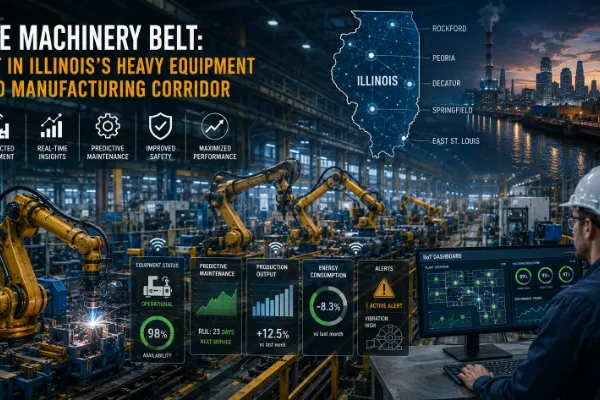
John Deere was founded in Grand Detour, Illinois in 1837 189 years ago and the company still headquarters its global operations at One John Deere Place in Moline. Caterpillar, one of the world's largest heavy equipment manufacturers, has run its Track-Type Tractors Division out of East Peoria since 1925. This isn't incidental history; Illinois remains a top-five U.S. manufacturing state with roughly 13,000 manufacturing establishments employing 570,000 people, and the heavy equipment corridor running from the Quad Cities through Peoria represents one of the most technologically sophisticated pieces of that broader manufacturing base a corridor where IIoT investment isn't a future ambition but an active, ongoing transformation of how the equipment itself gets built.
John Deere's Davenport Works facility, sitting in the Quad Cities manufacturing region that spans the Illinois-Iowa border alongside the company's Illinois operations, was named 2025 Assembly Plant of the Year specifically for its adoption of 5G connectivity, artificial intelligence, data analytics, and digital twin technology productivity-enhancing tools the recognizing publication specifically noted put the more-than-a-century-old company "miles ahead of many companies when it comes to adopting 21st century technology." The 5G deployment matters in a genuinely practical way for a heavy equipment assembly environment specifically: unlike a typical wired factory network, 5G connectivity supports the kind of mobile, reconfigurable sensor and equipment tracking that a large-format assembly operation building excavators, combines, and other heavy machinery that physically move through multiple assembly stages requires considerably more than a smaller-footprint electronics or consumer goods manufacturing line would.
Caterpillar's Track-Type Tractors Division in East Peoria employs approximately 2,200 workers across an estimated 35 million square feet of manufacturing space, holding ISO 9001 certification and manufacturing heavy earth-moving equipment sold under the CAT brand globally. At this scale, quality control and equipment monitoring can't realistically depend on manual inspection alone a facility this large requires the kind of continuous, sensor-driven monitoring covered in more depth in this site's broader coverage of Illinois manufacturing quality control, simply because the physical scale of the operation makes comprehensive manual oversight logistically impossible. Caterpillar has been a widely cited industry example of using IoT and augmented reality specifically to improve machine operation and maintenance both for the equipment the company manufactures and, by extension, the manufacturing equipment used to build it.
Beyond John Deere and Caterpillar specifically, Illinois hosts a genuinely dense concentration of agricultural and heavy equipment manufacturing, including major OEMs like AGCO and CNH Industrial alongside hundreds of smaller specialty implement manufacturers producing tillage equipment, planters, sprayers, and precision agriculture technology across the broader Midwest supply chain. John Deere's Milan, Illinois Parts Distribution Center, operating continuously since 1973 and employing roughly 1,200 people, illustrates how this manufacturing base extends well beyond final assembly into the parts logistics and distribution infrastructure that keeps deployed equipment operational across farms and job sites nationally a category where IIoT-driven inventory and demand forecasting increasingly determines how quickly a farmer or contractor can actually get a replacement part when equipment fails in the field.
Illinois continues attracting genuinely new manufacturing investment alongside its established heavy equipment base Hyundai Translead, a global trailer manufacturer, committed in 2026 to establishing new manufacturing operations in Will County, expanding its North American footprint into the state. This kind of new-entrant investment matters for understanding Illinois's manufacturing corridor honestly: it's not purely a story of legacy companies maintaining decades-old facilities, but one where new manufacturers continue choosing Illinois specifically for its combination of skilled workforce, established supply chain infrastructure, and the state's genuinely strong transportation network the nation's third-largest interstate highway system, the most connected intermodal rail network in the country, and major inland waterway access for barge transport, all factors that matter as much for IIoT-enabled just-in-time manufacturing logistics as they do for the underlying heavy equipment production itself.
Illinois's manufacturing workforce pipeline runs through a genuinely substantial combination of research universities the University of Chicago, University of Illinois, and Northwestern among them alongside a robust community college ecosystem producing graduates specifically trained in supply chain automation, computer-integrated manufacturing, and CNC and CAM programming. This educational infrastructure matters directly for the IIoT transformation happening across facilities like Davenport Works and East Peoria: sophisticated sensor networks and AI-driven manufacturing analytics only deliver value when paired with technicians and engineers capable of interpreting and acting on the resulting data, and Illinois's manufacturing workforce training pipeline represents a genuine, if often overlooked, piece of what's made the state's heavy equipment corridor viable for this level of technology investment.
The Quad Cities region straddling the Illinois-Iowa border, home to John Deere's Davenport Works alongside significant Illinois-side operations, illustrates a genuinely important dynamic for understanding Illinois's heavy equipment corridor: the state's manufacturing base doesn't operate in geographic isolation, but as part of a broader, cross-border industrial cluster where suppliers, logistics infrastructure, and skilled labor move fluidly across the Mississippi River separating the two states. For IIoT vendors and technology providers evaluating this market, treating the Quad Cities as a single integrated manufacturing region, rather than segmenting strategy strictly along the state line, better reflects how the corridor's actual supply chain and workforce relationships function in practice.
For the smaller suppliers and component manufacturers that make up the broader ecosystem feeding into Illinois's major heavy equipment OEMs, the IIoT sophistication now standard at facilities like Davenport Works and East Peoria increasingly sets an implicit bar for supplier qualification a smaller manufacturer supplying components to John Deere or Caterpillar needs quality control and traceability documentation increasingly generated by connected sensor systems rather than manual inspection logs, simply because the OEM's own quality systems are built around receiving that kind of structured, continuously verified supplier data. This dynamic, covered in more depth in this site's broader coverage of Illinois manufacturing quality control and retrofit strategy, means IIoT adoption pressure flows down through Illinois's manufacturing supply chain from the corridor's largest employers, not just from each individual manufacturer's own independent efficiency calculation.
For IIoT technology vendors specifically evaluating Illinois's heavy equipment corridor as a target market, it's worth understanding that the corridor's largest employers already operate at a genuinely sophisticated technology baseline a vendor pitching basic sensor monitoring to a facility like Davenport Works or East Peoria is pitching capability these operations have already implemented at scale. The more realistic opportunity for most IIoT vendors lies with the broader ecosystem of smaller suppliers and component manufacturers feeding into these major OEMs, where the technology adoption gap relative to the corridor's largest employers remains genuinely significant, and where the OEM supplier qualification pressure covered above creates real, near-term adoption urgency rather than a purely discretionary efficiency upgrade decision.
Frequently asked questions
John Deere is headquartered in Moline, Illinois, having been founded in nearby Grand Detour in 1837 189 years of continuous Illinois presence.
The facility was specifically recognized for adopting 5G connectivity, artificial intelligence, data analytics, and digital twin technology as productivity-enhancing tools.
The Track-Type Tractors Division employs approximately 2,200 workers across an estimated 35 million square feet, holding ISO 9001 certification and manufacturing heavy earth-moving equipment sold globally.
Yes. Hyundai Translead, a global trailer manufacturer, committed in 2026 to establishing new manufacturing operations in Will County, illustrating continued new-entrant investment alongside the state's established manufacturers.
Institutions including the University of Illinois and a robust community college ecosystem train graduates specifically in supply chain automation, computer-integrated manufacturing, and CNC/CAM programming, supporting the technical workforce IIoT-driven facilities require.
Smaller component manufacturers increasingly need connected quality control and traceability systems to meet major OEM supplier qualification requirements, since large manufacturers' own quality systems are built around receiving structured, continuously verified supplier data.
Related articles

 Industrial IoT (IIoT)