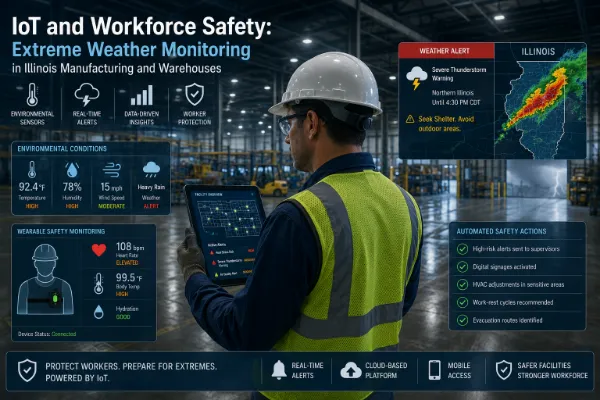
Illinois is attempting something genuinely unusual in U.S. workplace safety regulation: becoming the first Fed/OSHA state meaning a state that relies on federal OSHA rather than running its own state-run occupational safety program to adopt a general industry standard covering both excessive heat and excessive cold. House Bill 3762, the Workplace Extreme Temperature Safety Act, would direct the Illinois Department of Labor to establish enforceable temperature-related illness and injury prevention standards covering both indoor and outdoor work environments. As of early 2026, the bill remains under active legislative consideration rather than enacted law, with its original January 2026 rulemaking deadline having slipped as lawmakers continue revising the proposal toward a target of standards taking effect by the beginning of 2027. For Illinois manufacturers and warehouse operators, understanding this pending legislation now and building IoT monitoring capability ahead of it offers genuine strategic advantage regardless of exactly when it takes final effect.
Most states pursuing their own workplace heat regulation, including states like Nevada and California covered in more detail elsewhere on this site, operate their own State Plan under federal OSHA authorization, giving them clearer legal authority to adopt rules addressing hazards federal OSHA also regulates. Illinois operates under federal OSHA jurisdiction directly rather than its own State Plan, and normally Fed/OSHA states are preempted from adopting rules addressing hazards already regulated at the federal level. But because federal OSHA's own heat rule remains only a proposed standard rather than a finalized one, there's currently nothing for Illinois's proposed rule to conflict with a genuine regulatory opening that legal analysts have specifically noted could set a precedent for other Fed/OSHA states to pursue similar state-level standards while the federal rulemaking process remains stalled.
Under the bill's current provisions, interim temperature thresholds pending formal rulemaking would trigger employer obligations at an outdoor heat index of 80°F, and indoor thresholds combining a temperature of 80°F with a heat index of 85°F. Covered employers would need to develop and maintain a written occupational temperature-related illness and injury prevention plan, provided annually to the Illinois Department of Labor, employees, and any employee representatives by the last business day of May each year, with genuine anti-retaliation protections letting employees refuse unsafe work and pursue legal action if they face adverse consequences for reporting unsafe temperature conditions. Critically, unlike most state-level heat rules that address only heat, Illinois's proposed standard explicitly covers excessive cold as well a genuinely distinctive feature directly relevant to the state's demanding winter conditions covered in more detail in this site's broader coverage of Illinois's polar vortex challenges.
Illinois manufacturing and warehouse facilities face genuinely serious risk at both temperature extremes given the state's dual-season climate summer heat stress in non-air-conditioned warehouses and foundries, and winter cold stress in facilities with large loading dock doors, unheated storage areas, or equipment failures during extreme cold events. A heat-only regulatory framework, like several other states have adopted, would leave a genuine regulatory gap for Illinois manufacturers given how directly the state's winter conditions create their own distinct worker safety risk cold stress, slip-and-fall injuries on ice-affected loading docks, and equipment malfunction risk in unheated facility zones during the kind of subzero cold events covered in more detail elsewhere on this site. Illinois's proposed dual-extreme approach reflects a more complete recognition of the actual seasonal risk profile facing the state's manufacturing and warehouse workforce than a heat-only standard would provide.
Given the genuine uncertainty around exactly when Illinois's proposed standard will take final effect a timeline that's already slipped once and remains subject to further legislative revision manufacturers and warehouse operators shouldn't wait for final enactment before building the underlying IoT monitoring infrastructure the eventual standard will likely require. Continuous temperature and heat index monitoring across facility zones, automated threshold alerting tied to the specific 80°F and 85°F trigger points already documented in the bill's current interim provisions, and timestamped documentation generation matching the kind of written plan and annual reporting requirements the bill envisions all represent genuine operational value independent of the law's final form reducing actual worker injury risk and improving documented compliance posture regardless of precisely when, or in exactly what final form, Illinois's standard eventually takes effect.
Federal OSHA's own enforcement activity provides additional near-term motivation independent of Illinois's pending state legislation OSHA's original Heat National Emphasis Program expired April 8, 2026, and was replaced just two days later with a revised, expanded emphasis program running through April 2031, actively prioritizing inspections in high-risk industries including manufacturing and warehousing. This means Illinois manufacturers face genuine federal enforcement exposure right now under the General Duty Clause and OSHA's active heat emphasis program, entirely independent of whether Illinois's own state-specific standard is finalized on its original, revised, or some further-delayed timeline making continuous monitoring and documentation a near-term compliance priority regardless of the state legislative outcome.
Given that the bill's sponsor has been actively soliciting input from industry leaders to shape possible amendments as the legislation moves through further revision, Illinois manufacturers have a genuine, active opportunity to help shape the standard's final requirements before enactment, rather than simply waiting to react to a finished rule. Manufacturers already operating IoT-based temperature monitoring systems are generally better positioned to provide informed, evidence-based feedback during this amendment process able to speak from real operational data about which threshold levels and documentation requirements are genuinely practical to implement versus which provisions might need refinement, a substantive advantage over manufacturers without comparable monitoring infrastructure already in place attempting to weigh in on the same legislative discussion.
For Illinois manufacturing and warehouse facilities, the practical sequencing given this genuinely uncertain but clearly directionally moving regulatory environment should prioritize continuous zone-level temperature and heat index monitoring covering both extremes not just summer heat, given the genuine winter cold risk the state's proposed standard specifically recognizes paired with the kind of automated documentation generation that satisfies both federal OSHA's active heat emphasis program today and positions the facility well for whatever specific form Illinois's own dual-extreme standard eventually takes once finalized.
Frequently asked questions
House Bill 3762 would direct the Illinois Department of Labor to establish enforceable standards covering both excessive heat and excessive cold in indoor and outdoor workplaces, remaining under active legislative consideration as of early 2026 with a revised target of taking effect by the beginning of 2027.
Fed/OSHA states are normally preempted from regulating hazards federal OSHA already addresses, but because federal OSHA's heat rule remains only proposed rather than finalized, Illinois has a genuine regulatory opening other Fed/OSHA states could potentially follow.
Interim provisions would trigger employer obligations at an outdoor heat index of 80°F and indoor conditions combining an 80°F temperature with an 85°F heat index, pending final rulemaking.
Illinois's demanding dual-season climate creates genuine worker safety risk at both extremes summer heat stress and winter cold stress with associated slip-and-fall and equipment malfunction risks unlike states with heat-only regulatory frameworks.
No. Building continuous temperature monitoring and documentation infrastructure now delivers genuine value regardless of final legislative timing, given both the pending state standard and active federal OSHA enforcement under the current Heat National Emphasis Program.
Yes. OSHA's expanded National Emphasis Program on heat-related hazards runs through April 2031 and actively prioritizes inspections in high-risk industries including manufacturing and warehousing, creating genuine enforcement exposure regardless of Illinois's state legislative outcome.
Related articles

 Manufacturing IoT