Illinois's roughly 13,000 manufacturing establishments span a genuinely wide range of facility ages, from newly announced operations like Hyundai Translead's Will County trailer plant down to factory floors that have been running continuously since well before modern sensor technology existed. For the considerable share of Illinois manufacturers operating in this older category a genuine legacy of the state's deep, decades-spanning industrial history the practical question isn't whether IIoT technology could help, it's how to add it without requiring the kind of extended production shutdown that a full rip-and-replace equipment overhaul would demand.
The most common mistake in legacy factory retrofit projects is starting with a specific sensor technology or vendor platform before honestly cataloging what's actually running on the floor. For an older Illinois facility, this inventory needs to go beyond simple equipment age and include documentation status does genuine manufacturer specification data still exist for this specific machine, or has that documentation been lost across decades of ownership changes and facility transitions? Equipment with intact documentation can often support a faster, more confidently calibrated sensor deployment, while genuinely undocumented equipment, common across Illinois's older industrial base covered in more detail in this site's coverage of predictive maintenance for aging facilities, requires the longer baseline-establishment period discussed there before sensor data becomes fully reliable.
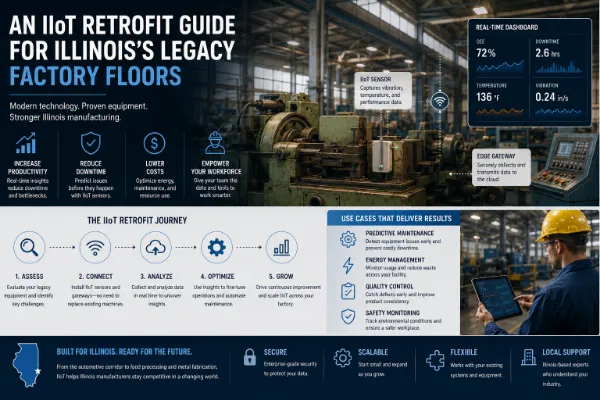
For genuinely legacy equipment machinery installed well before any consideration of network connectivity wireless vibration, thermal, and current sensors mounted externally, without disturbing existing control logic or wiring, represent the realistic entry point for most Illinois manufacturers. This approach avoids the extensive rewiring and control system modification that a wired retrofit would require, sidestepping the production downtime that installing monitoring equipment would otherwise cost a genuinely important consideration for a facility that can't easily absorb an extended shutdown simply to add the technology meant to reduce future unplanned downtime. The cost of this category of wireless retrofit sensor has fallen substantially in recent years, making it a realistic option even for smaller Illinois manufacturers without the capital budget a facility like Caterpillar's East Peoria operation, covered in more detail in this site's broader coverage of Illinois's heavy equipment manufacturing corridor, can bring to a comparable technology investment.
Illinois manufacturers, particularly those serving agricultural equipment supply chains covered elsewhere on this site, often carry genuine seasonal production patterns tied to planting and harvest cycles meaning a retrofit deployment timed around a facility's natural lower-production period can meaningfully reduce the disruption cost of installation work, even for the minimally invasive wireless sensor approach covered above. A facility manager planning an IIoT retrofit should map the deployment schedule against the company's own production calendar specifically, rather than defaulting to whatever timeline a vendor proposes, since a vendor without deep familiarity with Illinois's agricultural-adjacent manufacturing rhythm may not naturally account for this seasonal variation in their proposed installation schedule.
Beyond sensor addition, a genuinely comprehensive legacy retrofit typically needs to bridge decades-old programmable logic controllers and control system protocols to a modern, centralized monitoring and analytics platform a technical challenge distinct from simply adding new sensors, since older Illinois manufacturing equipment often runs communication protocols that predate the more standardized industrial networking protocols common in newer equipment. This bridging work typically requires a protocol gateway or translation layer specifically capable of interpreting a legacy control system's native communication format and converting it into a format a modern analytics platform can actually use a genuinely specialized technical requirement that not every general-purpose IIoT vendor has deep experience with, making vendor selection for this specific piece of a legacy retrofit considerably more consequential than the sensor hardware selection itself.
For an Illinois manufacturer building an internal case for legacy retrofit investment, the most persuasive framing typically connects directly to costs the facility is already absorbing rather than a general efficiency argument: pulling a year of unplanned downtime incidents and calculating how many could plausibly have been caught days or weeks in advance by continuous monitoring turns an abstract technology pitch into a number tied to the facility's own operating history. Given the rising regional electricity cost pressure covered in more detail in this site's coverage of Illinois's aging industrial base, quantifying how much energy an inefficiently operating piece of aging equipment is actually consuming relative to its original design specification where that specification still exists provides a second, independent line of financial justification beyond downtime reduction alone.
- Months 1-2: Equipment inventory and documentation audit, identifying which machines have intact manufacturer specifications versus which will require baseline establishment from scratch.
- Months 2-4: Pilot deployment on the single highest-consequence equipment category, prioritizing whichever machine or process represents the highest cost of unplanned downtime, rather than attempting facility-wide coverage immediately.
- Months 4-8: Baseline establishment and calibration, a period that runs longer for genuinely undocumented legacy equipment than for newer machinery with existing manufacturer data.
- Months 8-12 and beyond: Phased expansion to additional equipment categories, informed by what the pilot deployment actually revealed about the facility's specific failure patterns and monitoring priorities.
Illinois's community college and university manufacturing training ecosystem, covered in more detail in this site's coverage of the state's broader heavy equipment manufacturing corridor, represents a genuinely underused resource during a legacy retrofit project specifically. Rather than relying entirely on a vendor's own installation and training team, manufacturers undertaking a multi-phase retrofit like the one outlined above can often partner directly with regional community college programs to develop in-house sensor calibration and data interpretation capability alongside the deployment itself building internal expertise during the retrofit process rather than remaining dependent on external vendor support for every subsequent adjustment or expansion phase.
For an Illinois manufacturer operating equipment that predates modern connectivity by decades, the practical path forward isn't a comprehensive, all-at-once IIoT transformation it's a disciplined, phased approach starting with honest equipment documentation, wireless retrofit sensors on the highest-consequence machinery first, and realistic expectations about how long genuinely undocumented legacy equipment takes to generate reliable predictive data. This measured approach, informed by the specific realities of Illinois's older industrial base rather than a generic retrofit template built around newer equipment, gives manufacturers a genuinely achievable path toward the same predictive maintenance and quality control capability increasingly standard at the state's largest, newest facilities.
Frequently asked questions
Conduct an honest equipment inventory that includes documentation status, distinguishing machines with intact manufacturer specifications from genuinely undocumented legacy equipment that will require a longer baseline-establishment period.
They avoid the extensive rewiring and control system modification a wired retrofit would require, sidestepping the production downtime that installing monitoring equipment would otherwise cost.
Yes. Manufacturers serving agricultural supply chains often have seasonal production patterns tied to planting and harvest, and timing retrofit installation around natural lower-production periods can meaningfully reduce disruption.
Older Illinois manufacturing equipment often runs communication protocols that predate standardized industrial networking, requiring a specialized protocol gateway or translation layer that not every general-purpose IIoT vendor has deep experience implementing.
A phased approach typically spans about a year: two months for equipment inventory, two to four months for pilot deployment on the highest-consequence equipment, four to eight months for baseline calibration, and continued phased expansion afterward.
Connecting the investment directly to costs the facility already absorbs a year of unplanned downtime incidents and the energy cost of inefficiently operating aging equipment relative to its original design specification rather than a general efficiency argument.
Related articles

 Industrial IoT (IIoT)