Illinois's largest health systems don't operate within a single metro area the way many comparable regional systems do elsewhere in the country. OSF HealthCare's network spans Central Illinois, the Metro East region near St. Louis, and Rockford in the north genuinely distant, distinct geographic markets under one health system, covered in more detail in this site's coverage of Illinois telehealth infrastructure. This kind of dispersed, multi-region footprint, common across several of Illinois's largest systems, creates a genuinely different hospital asset tracking challenge than a health system operating entirely within a single dense metro area, where equipment can realistically be redistributed between facilities within the same day if needed.
A hospital system spanning hundreds of miles between facilities from Rockford in the north to the Metro East near St. Louis in the south, in OSF HealthCare's case specifically faces asset visibility challenges that a compact, single-city system simply doesn't. Equipment shortages at one facility can't be solved by simply walking a spare unit across town from a sister facility the way they might within a dense urban health system; a facility manager needs genuine, real-time visibility into where every piece of mobile equipment actually sits across the entire multi-region network before deciding whether redistributing existing inventory is even a realistic near-term solution, or whether a shortage genuinely requires new procurement. Without comprehensive, real-time tracking spanning the full geographic footprint, equipment allocation decisions default to guesswork or historical assumptions about where inventory "should" be, rather than data reflecting where it actually is at any given moment.
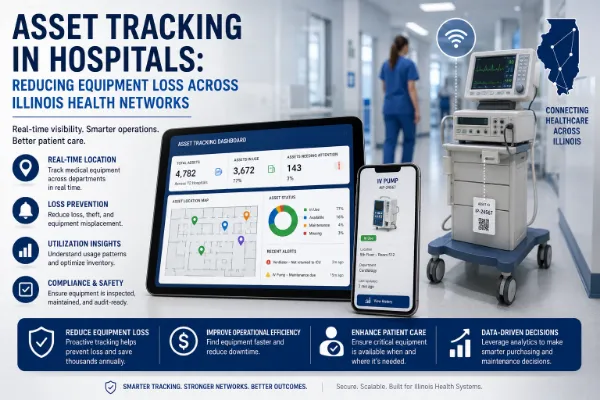
The financial case for hospital asset tracking documented nationally applies with particular force to a network spanning Illinois's genuine geographic diversity: a typical 300-bed facility loses $1 million to $2 million annually to missing or underutilized assets, and a well-documented industry example found a 380-bed hospital carrying 1,200 IV pumps at just 30% utilization before implementing tracking technology a number that dropped to 780 units once real utilization visibility revealed the actual clinical need, representing more than $1 million in capital savings from a single equipment category. For a multi-facility Illinois system, this kind of over-purchasing risk compounds specifically because facilities without shared, real-time visibility into each other's actual equipment utilization tend to independently over-provision for their own worst-case scenario, rather than drawing on system-wide inventory that a comprehensive tracking platform would reveal is already sufficient in aggregate.
Real-time location systems for hospital equipment generally combine several core technologies, each suited to different facility needs within a genuinely varied Illinois network:
- Bluetooth Low Energy (BLE) beacons attached to equipment, providing room-level or zone-level location accuracy at reasonable cost the most practical baseline approach for general equipment tracking across a system's full facility footprint, from a large urban academic medical center down to a smaller rural critical access hospital.
- Ultra-Wideband (UWB) delivers sub-meter accuracy particularly valuable in high-acuity environments like trauma bays and emergency departments at a system's larger regional hub facilities, where locating specific equipment within seconds carries genuine clinical urgency.
- Cloud-based, cross-facility dashboards that aggregate location data across every facility in a multi-region system into a single, unified view the genuinely essential layer for an Illinois network spanning distances that make any facility-by-facility, siloed tracking approach considerably less useful than it would be in a single-metro system.
For an Illinois health system spanning multiple distinct regions, the real value of hospital asset tracking technology comes specifically from the cross-facility aggregation layer, not just individual facility-level implementation. A large Chicago-area academic medical center and a smaller downstate critical access hospital within the same broader system, covered in more detail in this site's coverage of Illinois's rural-urban health access divide, likely have genuinely different equipment utilization patterns and different capital budgets but a shared, system-wide tracking platform lets network leadership make allocation decisions that account for both facilities' actual needs simultaneously, potentially redistributing underutilized equipment from a lower-volume rural facility to a higher-demand urban hub, or vice versa during a specific seasonal surge, rather than each facility operating its equipment inventory in isolation from the broader network's actual capacity.
Given the genuine financial pressure facing Illinois's rural hospitals, covered in more detail elsewhere on this site, asset tracking technology carries particular weight for smaller critical access facilities specifically: every dollar of avoided unnecessary capital equipment spending matters more for a rural hospital already navigating the kind of Medicaid reimbursement pressure and charity care cost pressure documented across the state's rural health sector. A rural facility's participation in a larger system's shared, cross-facility asset tracking and allocation platform rather than maintaining its own isolated, facility-specific equipment inventory offers a genuine, practical way to access equipment flexibility that an independent, unaffiliated rural hospital of comparable size likely couldn't achieve on its own, given the fixed capital costs involved in any hospital independently maintaining full equipment redundancy for every possible demand scenario.
The internal argument for asset tracking investment looks somewhat different depending on which part of a multi-region Illinois system is making the case. A large urban academic medical center's facilities team might focus the pitch on reducing rental costs for equipment covering temporary shortages during peak demand periods, while a rural critical access facility within the same broader system might build the case around avoiding an independent capital purchase entirely by demonstrating that comparable equipment already sits underutilized at a sister facility elsewhere in the network. Pulling a year of equipment rental and emergency purchase records from both facility types and identifying how many of those costs could have been avoided through better system-wide visibility turns an abstract efficiency argument into a concrete number system leadership can act on directly.
For an Illinois health system spanning multiple regions, the practical implementation sequencing should prioritize the cross-facility dashboard and data aggregation layer early, rather than treating each facility's tracking deployment as an independent project to be connected later a piecemeal, facility-by-facility rollout risks recreating exactly the kind of siloed visibility gap that makes multi-region asset management difficult in the first place. Starting with the highest-value equipment category system-wide, rather than achieving comprehensive tracking at a single flagship facility first, tends to deliver more representative early results given how directly the technology's core value in Illinois's specific context depends on cross-region visibility rather than single-site depth.
Frequently asked questions
Systems like OSF HealthCare span genuinely distant regions Rockford, Central Illinois, and the Metro East near St. Louis meaning equipment shortages can't be solved by simple facility-to-facility redistribution the way they might within a single dense metro health system.
A typical 300-bed facility loses $1 million to $2 million annually to missing or underutilized assets, and a documented example shows one hospital reducing its IV pump fleet from 1,200 to 780 units after gaining real utilization visibility, saving more than $1 million.
Cloud-based, cross-facility dashboards aggregating location data across every facility in the network matter more than facility-level tracking alone, since the real value comes from system-wide visibility spanning genuinely distant regions.
Given genuine financial pressure facing rural facilities, avoiding unnecessary capital equipment spending matters more, and participation in a larger system's shared tracking platform offers equipment flexibility an independent rural hospital likely couldn't achieve alone.
Generally not as the primary approach prioritizing the cross-facility dashboard layer early avoids recreating the kind of siloed visibility gap that makes multi-region equipment management difficult, since the technology's core value depends on cross-region visibility.
Yes. A shared, system-wide platform lets network leadership identify underutilized equipment at one facility and redistribute it to another facing higher demand, rather than each facility operating its inventory in isolation.
Related articles

 Healthcare IoT