Autonomous freight corridor advocates have specifically named the Midwest's I-70 and I-80 highways "sleeping giants with big potential" for self-driving truck deployment but as of 2026, the actual commercial autonomous trucking activity generating headlines is happening considerably further south. International and Ryder have a Level 4 autonomous truck running a genuine 600-mile daily commercial route on Texas's I-35 corridor between Laredo and Temple, hauling real customer freight with safety drivers monitoring rather than actively driving. Illinois, despite carrying some of the heaviest truck freight volume of any state in the country and sitting at the physical crossroads of the national interstate system, isn't yet home to comparable driverless commercial operations an honest gap worth understanding clearly before evaluating what IoT and autonomous technology actually means for Illinois trucking right now.
I-80, the second-longest interstate highway in the country at roughly 2,900 miles, runs directly through northern Illinois as part of a designated Tier I freight corridor one of the relatively few highways in the country carrying freight coast to coast on a single continuous route. More broadly, Chicago's freight network includes 42 urban interstates, freeways, and expressways, with average combination truck traffic reaching nearly 20,000 vehicles per day on the busiest of these routes. The autonomous freight corridor concept specifically favors exactly this kind of long-haul, freight-heavy interstate segment highway stretches without the pedestrians, parallel parking, and four-way stop complexity that make autonomous passenger vehicle deployment in dense urban environments so much harder meaning Illinois's interstate network carries genuine structural advantages for this technology, even without current commercial deployment to show for it yet.
The honest reason autonomous trucking has concentrated in Texas and Arizona rather than Illinois isn't primarily about highway suitability it's regulatory. There's currently no unified federal framework governing autonomous commercial vehicles in the United States, with each state maintaining its own rules: Texas and Arizona have adopted genuinely permissive frameworks, while other states impose considerably more restrictive requirements, and federal harmonization isn't expected until 2027 or 2028 at the earliest. The federal SELF DRIVE Act of 2026 represents genuine movement toward that harmonized framework, establishing federal rules for cab-less vehicles, testing permits, and interstate operations but its practical effect on where companies actually choose to deploy commercial autonomous fleets in the near term still depends heavily on each individual state's existing regulatory posture, and Illinois hasn't emerged as an early-mover permissive state the way Texas and Arizona have.
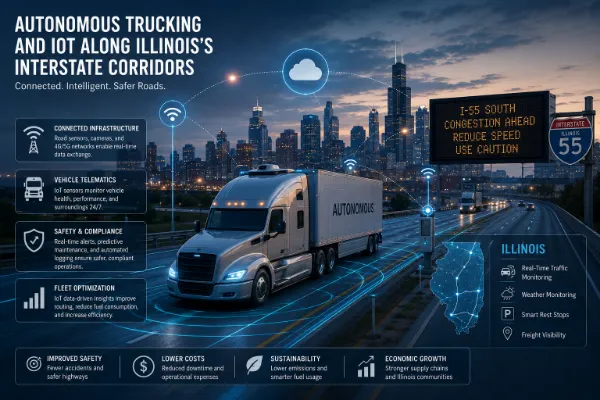
Rather than driverless Level 4 trucks, the IoT technology genuinely active on Illinois's freight corridors today centers on connected fleet telematics and driver-assist systems supporting conventional, human-driven trucking operations real-time GPS tracking, electronic logging devices, predictive maintenance sensors on truck engines and components, and increasingly sophisticated advanced driver assistance systems (ADAS) that provide automated braking, lane-keeping, and collision avoidance without removing the human driver from the vehicle. With more than 5,989 trucking companies operating in Illinois, covered in more detail in this site's coverage of Chicago's broader freight infrastructure, this conventional fleet IoT technology represents the genuinely deployed, revenue-generating technology layer Illinois trucking companies are actually investing in right now, distinct from the more speculative driverless deployment still concentrated elsewhere.
Illinois and Indiana's proposed Illiana Corridor, designed primarily to relieve I-80 congestion by shifting freight traffic south of Chicago's densest urban core, covered in more detail in this site's coverage of the region's rail infrastructure, represents a genuinely interesting potential long-term intersection with autonomous freight corridor development. A newly constructed highway segment, built specifically for freight movement and bypassing the dense urban complexity that makes autonomous deployment hardest, would align naturally with the "build the road for the robot" philosophy autonomous freight corridor advocates specifically favor new infrastructure genuinely gives planners more flexibility to incorporate the digital and physical design elements autonomous trucking eventually requires than retrofitting an already-built, decades-old highway segment would allow.
Genuine autonomous freight corridor development, beyond the vehicles themselves, requires vehicle-to-everything (V2X) capable infrastructure roadside sensors and communication systems that let autonomous trucks receive real-time data about traffic conditions, road hazards, and infrastructure status well beyond what onboard vehicle sensors alone can detect. Illinois currently lacks this kind of purpose-built V2X infrastructure along its major freight corridors, representing a genuine, quantifiable infrastructure investment gap relative to states actively piloting autonomous freight operations. This is precisely the kind of infrastructure question that connects directly to the broader digital twin and infrastructure modernization investment covered in more detail in this site's coverage of Illinois's $50.6 billion Rebuild Illinois program a program not currently scoped around V2X-specific autonomous vehicle infrastructure, but one that represents the kind of large-scale, multi-year capital investment vehicle that could eventually incorporate this category of infrastructure if state policy priorities shift in that direction.
Illinois trucking companies and infrastructure planners can draw genuinely useful lessons from watching how Texas and Arizona's early permissive regulatory frameworks have actually played out in practice, rather than needing to independently discover the same operational lessons once Illinois eventually opens its own regulatory door to driverless deployment. International's hub-to-hub model, running toward complete driverlessness with a 24/7 remote control tower monitoring vehicles and dispatching roadside assistance when a truck's autonomous system detects a mechanical issue and executes a minimum-risk pullover maneuver, illustrates the kind of remote monitoring and rapid-response infrastructure Illinois would eventually need to build alongside any future autonomous deployment on corridors like I-80 a genuinely different operational support model than conventional trucking's driver-centric roadside assistance approach.
For Illinois-based trucking and logistics companies evaluating how to prepare for eventual autonomous freight deployment, the practical near-term priority is building out the connected fleet telematics and driver-assist technology genuinely available and deployable today, rather than waiting for driverless technology to arrive in Illinois specifically before making any IoT investment at all. Given how directly modern autonomous truck fleet management software increasingly standardizes around the same underlying data infrastructure vehicle position, condition monitoring, route optimization that conventional connected fleet telematics already uses, Illinois companies building strong telematics and driver-assist infrastructure now are building a genuinely transferable technology foundation for whatever timeline autonomous deployment eventually follows in this specific state, rather than starting from scratch whenever that transition eventually arrives.
Frequently asked questions
Not yet commercially. Actual Level 4 autonomous commercial trucking activity in 2026 is concentrated in Texas, including a genuine 600-mile daily route on I-35 between Laredo and Temple, though industry analysts have specifically identified Illinois's I-70/I-80 corridors as strong future candidates.
The gap is primarily regulatory rather than infrastructure-related there's no unified federal framework yet, and Texas and Arizona have adopted more permissive state-level rules than Illinois currently has in place.
Federal legislation establishing rules for cab-less autonomous vehicles, testing permits, and interstate operations, representing movement toward the federal regulatory harmonization expected more fully by 2027-2028.
Connected fleet telematics, real-time GPS tracking, electronic logging devices, predictive maintenance sensors, and advanced driver assistance systems supporting conventional, human-driven trucking operations, rather than driverless technology.
Vehicle-to-everything infrastructure lets autonomous trucks receive real-time data about traffic and road conditions beyond onboard sensors alone; Illinois currently lacks this purpose-built infrastructure along its major freight corridors.
As new infrastructure built specifically for freight movement, it would align naturally with autonomous freight corridor design principles, offering more flexibility than retrofitting older highway segments for future digital and physical requirements.
Related articles

 Logistics & Transportation