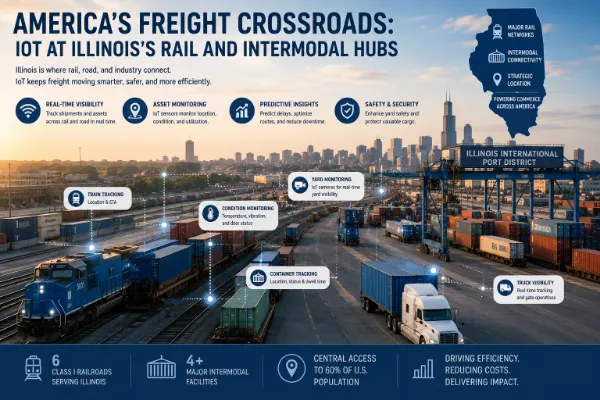
Chicago is the only place in North America where all six of the continent's Class I freight railroads physically converge. Roughly a quarter of all U.S. rail freight traffic either originates, terminates, or passes through the city, and by one Chicago Metropolitan Agency for Planning estimate, half of all intermodal trains in the entire country touch Chicago at some point in their journey. This concentration is a genuine economic asset but for decades it also created a genuinely dysfunctional operational bottleneck, captured memorably by Chuck Allen, the retired general manager of the Indiana Harbor Belt Railroad: "I know it's nuts, but NS runs trains from North Jersey to Chicago on CTC and BNSF does the same from Los Angeles to Chicago, but here in Chicago they were on an unsignaled railroad trying to reach each other." Untangling that bottleneck has become one of the more significant IoT and infrastructure modernization efforts in American freight logistics.
The Chicago Region Environmental and Transportation Efficiency Program CREATE is a $4.6 billion public-private partnership between the freight railroads, Amtrak, Metra, the Chicago Department of Transportation, IDOT, and federal transportation agencies, encompassing 70 individual projects designed to reduce congestion, improve safety, and increase capacity across Chicago's freight and passenger rail network simultaneously. As of recent reporting, roughly $2 billion of that total has already been spent untangling specific chokepoints. One completed project at BNSF's Corwith Yard the easternmost point of BNSF's transcontinental Los Angeles-to-Chicago route, the busiest intermodal corridor in the nation replaced aging signals and track with upgraded systems specifically to improve switch reliability, addressing what had been a particular problem during cold weather. This kind of sensor-driven signal and switch monitoring illustrates directly how IoT technology underlies CREATE's broader infrastructure investment: physical track and signal upgrades only deliver their full reliability benefit when paired with continuous condition monitoring that can detect a developing switch or signal problem before it causes a service disruption, particularly during Illinois's genuinely demanding winter conditions covered in more detail elsewhere on this site.
BNSF's Cicero Intermodal Terminal, spanning more than 250 acres, handles more than 1 million intermodal lifts annually, connecting with Union Pacific, CN, Norfolk Southern, and CSX through trackage rights and serving as a linchpin for both Midwest and national freight flows. Nearby, BNSF's Corwith facility, built originally by the Atchison, Topeka and Santa Fe Railway in 1888 and still operating on largely the same footprint today, processes approximately 1,900 containers daily using advanced container cranes and automated sorting technology. Illinois's rail sector overall supports more than 38,000 jobs and generates an estimated $9 billion in annual economic impact a scale that makes even incremental efficiency improvements from better IoT-driven monitoring and coordination genuinely consequential across the broader regional economy, not just within individual rail yards.
The core challenge CREATE addresses isn't capacity within any single railroad's own yard it's the coordination problem at the interchange points where one railroad's trains hand off to another's tracks, historically without the kind of centralized traffic control that would let dispatchers from different companies coordinate movements through shared infrastructure efficiently. CREATE's Western Avenue Corridor project, for example, creates a new connection between the CN Joliet Subdivision and other Chicago-area rail infrastructure specifically to give dispatchers greater flexibility routing trains through the Chicago terminal area, including improving the potential for steel-wheel interchange of cargo between railroads rather than requiring containers to be trucked between yards using local streets and highways. This kind of interchange coordination increasingly depends on real-time, shared visibility into train position, yard capacity, and track availability across company boundaries exactly the kind of cross-organizational IoT data-sharing infrastructure that a historically fragmented, multi-railroad hub like Chicago has needed to build from the ground up, rather than inheriting from a single, unified rail network design.
Beyond rail-specific improvements, Illinois and Indiana have collaborated on the proposed Illiana Corridor specifically to relieve congestion on I-80 in the greater Chicago area by shifting truck and passenger traffic south of the city's densest core a genuinely complementary strategy to CREATE's rail-focused improvements, given how directly intermodal rail efficiency and highway freight capacity interact in a hub with Chicago's combined rail-and-truck volume. With more than 5,989 trucking companies operating in Illinois as of mid-2025, and average combination truck traffic reaching nearly 20,000 vehicles per day on some of Chicago's busiest urban interstates, highway capacity constraints compound the same fundamental coordination challenge CREATE addresses on the rail side a bottleneck at any single point in this integrated rail-and-highway freight network creates ripple effects across the entire system.
A significant share of Chicago's intermodal rail traffic connects directly to one of the region's largest single freight generators: UPS's Chicago Area Consolidation Hub sits adjacent to BNSF's Willow Springs terminal specifically to enable rapid, efficient transfer between rail and UPS's own ground network. Willow Springs runs premium-priced expedited "Z" trains that routinely load and unload as many as 11 trains in and 12 trains out within a single day, with minimal dwell time between arrivals and departures an operational cadence that depends entirely on continuous, real-time coordination between rail scheduling and UPS's own package sorting and delivery timelines. This kind of tightly coupled, time-sensitive rail-to-parcel handoff illustrates exactly why IoT-driven, real-time coordination has become so consequential for Chicago's freight network specifically a delay of even a few hours at this specific interchange point ripples directly into UPS delivery commitments across a large share of its Midwest and national network.
For logistics companies and shippers relying on Chicago's rail and intermodal infrastructure, CREATE's continued progress and the underlying IoT-driven monitoring systems supporting it matter directly for shipment reliability planning a shipment routed through a Chicago interchange point still under active CREATE improvement work faces genuinely different reliability characteristics than one routed through an already-completed corridor. Given that CREATE remains an ongoing, multi-year program with roughly $2.6 billion in additional planned investment beyond what's already been spent, shippers and logistics planners should expect continued incremental reliability improvement at specific chokepoints over the coming years, rather than a single completion date after which all of Chicago's historical rail coordination challenges get resolved simultaneously.
Frequently asked questions
It's the only location where all six Class I freight railroads on the continent physically converge, with roughly 25% of all U.S. rail freight traffic passing through the city and an estimated half of all intermodal trains nationally touching Chicago at some point.
A $4.6 billion public-private partnership between freight railroads, Amtrak, Metra, and federal and state transportation agencies, encompassing 70 projects to reduce congestion and improve safety and capacity across Chicago's rail network, with roughly $2 billion already spent.
BNSF's Cicero terminal spans more than 250 acres and handles over 1 million intermodal lifts annually, while the nearby Corwith facility processes approximately 1,900 containers daily using automated sorting technology.
Switch reliability has historically been a particular problem during cold weather, which is why CREATE's Corwith Yard improvements specifically included upgraded signals and track designed to improve switch performance in winter conditions.
It's a proposed Illinois-Indiana collaboration to relieve I-80 congestion by shifting truck and passenger traffic south of Chicago's densest core, complementing CREATE's rail-focused improvements given how rail and highway freight capacity interact in the region.
No. With roughly $2.6 billion in additional planned investment beyond what's already been spent, CREATE remains an ongoing, multi-year program, and shippers should expect continued incremental reliability improvements at specific chokepoints over the coming years.
Related articles

 Logistics & Transportation